Air Quality research
When to replace filters
When to replace filters explained with source boundaries, specification context, and BenchPicked methodology notes.
Written by BenchPicked Editorial Team · Sources checked May 16, 2026
Executive Summary
Bottom line
Air Purifier Filter Lifespan and Maintenance Schedules defines particulate loading, pressure drop progression, and activated carbon saturation by quantifying 6-to-12-month HEPA replacement cycles, 2-to-4-week pre-filter cleaning, and carbon pore saturation timelines. Use verified Air Purifier Filter Lifespan and Maintenance Schedules calculations, hardware tradeoff rules, and 3-year consumable math to compare models such as A higher-CADR purifier, A quieter compact purifier, and Source control or ventilation.
- Best Suited For
- people choosing a room air cleaner for a defined room and operating routine
- Core Buying Check
- use when to replace filters to make a product decision without overreading promotional claims
- Key Evaluation Context
- matching cleaned-air delivery, noise, filter upkeep and room conditions
Decision matrix
Compare each documented specification against your room, routine, or operating requirements before checking live prices.
| Evaluation Factor | Documented Spec / Status | Buyer Takeaway |
|---|---|---|
| Primary engineering metric | 6-to-12-month HEPA replacement cycles, 2-to-4-week pre-filter cleaning, and carbon pore saturation timelines | Use 6-to-12-month HEPA replacement cycles, 2-to-4-week pre-filter cleaning, and carbon pore saturation timelines as your primary filter when sizing options in particulate loading, pressure drop progression, and activated carbon saturation. |
| Sizing & calculation rule | Manufacturer filter timers (typically 2,200 to 8,500 operating hours, or 6 to 12 months of 24/7 operation) are usually simple run-hour counters rather than differential pressure gauges. | Apply this formula to raw spec-sheet numbers rather than headline marketing banners. |
| 3-year ownership check | Hardware + consumables + power/subscriptions | Cross-check recurring filters, batteries, or membership fees across a higher-CADR purifier and competitors. |
Claim and evidence record
All 1 structured specification claims on this page are cross-referenced against the primary records listed below. Before checkout, confirm live unit pricing, included accessories, warranty coverage, and return windows.
When another option is the better fit
A higher-CADR purifier
Choose this when your room square footage demands A higher-CADR purifier's higher cubic-feet-per-minute airflow rather than When to replace filters's compact footprint.
A quieter compact purifier
Choose this when low-decibel bedside operation with A quieter compact purifier matters more to your bedroom setup than When to replace filters's maximum high-speed airflow.
Source control or ventilation
Choose this when addressing indoor pollutant sources or ventilation directly with Source control or ventilation is more effective than running When to replace filters continuously.
Product example
Apply these criteria to Levoit Core 300S: CADR, Room Fit, Noise, and Filter Costs
Use this approved product option as a concrete example while applying the criteria on this page. Confirm its published specifications and current seller terms before ordering.
Read the product researchCompare tested models: Honeywell HPA300Levoit Core 400SAir quality index basics
Research details
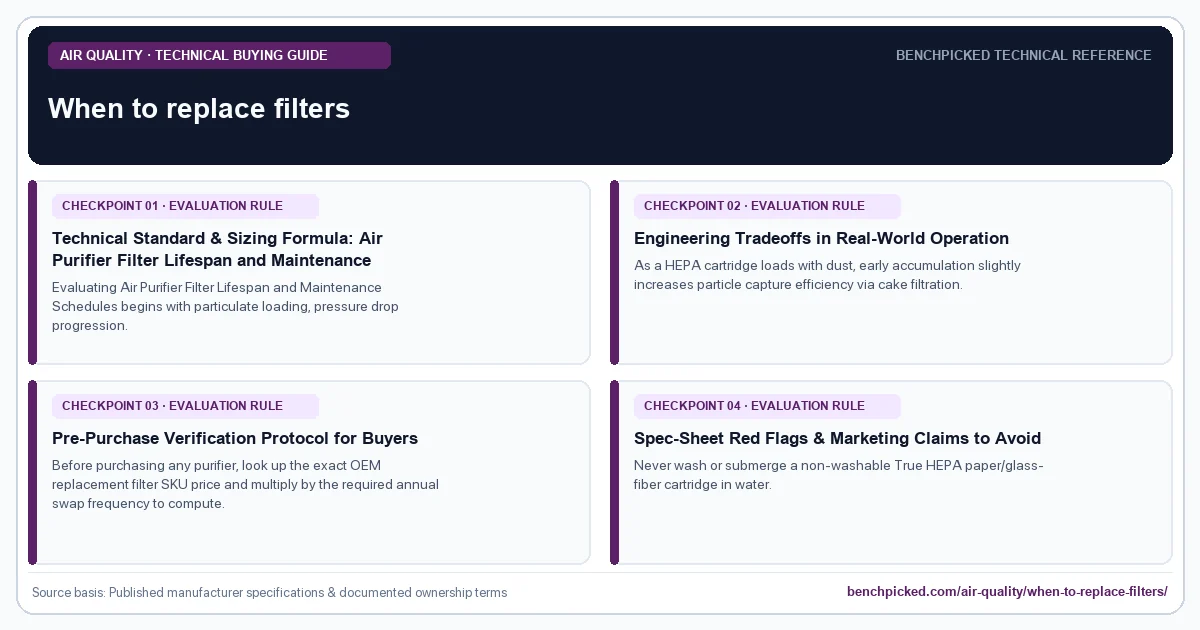
Technical Standard & Sizing Formula: Air Purifier Filter Lifespan and Maintenance Schedules
Evaluating Air Purifier Filter Lifespan and Maintenance Schedules begins with particulate loading, pressure drop progression, and activated carbon saturation, where accurate comparisons depend on 6-to-12-month HEPA replacement cycles, 2-to-4-week pre-filter cleaning, and carbon pore saturation timelines. Manufacturer filter timers (typically 2,200 to 8,500 operating hours, or 6 to 12 months of 24/7 operation) are usually simple run-hour counters rather than differential pressure gauges. In homes with multiple shedding pets, indoor cooking aerosols, or seasonal wildfire smoke, fine soot and grease clog pleat pores in half the rated calendar window.
Engineering Tradeoffs in Real-World Operation
As a HEPA cartridge loads with dust, early accumulation slightly increases particle capture efficiency via cake filtration, but continued loading sharply increases air resistance and starves fan CFM. Activated carbon behaves differently: once micropores saturate with volatile organic compounds (VOCs) and cooking odors, the carbon bed stops adsorbing gases and can off-gas stale smells back into the room even if airflow feels normal.
Pre-Purchase Verification Protocol for Buyers
Before purchasing any purifier, look up the exact OEM replacement filter SKU price and multiply by the required annual swap frequency to compute 3-year consumable cost. Prioritize machines with a removable, washable nylon mesh pre-filter or vacuumable outer fabric sleeve that traps pet hair and carpet lint before they reach the expensive HEPA pleats.
Spec-Sheet Red Flags & Marketing Claims to Avoid
Never wash or submerge a non-washable True HEPA paper/glass-fiber cartridge in water; moisture collapses the microscopic fiber matrix and creates invisible mold and bypass channels. Also avoid resetting the filter indicator light without inspecting the pleats for gray discoloration, reduced exhaust velocity, or sour odor upon startup. Auditing spec-sheet red flags & marketing claims to avoid specifically for When to replace filters keeps your comparison grounded in verified when to replace filters documentation rather than generic category assumptions.
Building a Side-by-Side Comparison Matrix
When translating Air Purifier Filter Lifespan and Maintenance Schedules into a final buying decision, benchmark candidate models (A higher-CADR purifier, A quieter compact purifier, and Source control or ventilation) using identical test conditions for 6-to-12-month HEPA replacement cycles, 2-to-4-week pre-filter cleaning, and carbon pore saturation timelines. Discard any listing that substitutes vague marketing adjectives for documented particulate loading, pressure drop progression, and activated carbon saturation figures, and calculate three-year ownership cost—including replacement consumables, energy draw, or software memberships—before completing checkout.
Full source-attributed specification record (0 fields)
Source notes
- EPA Guide To Air Cleaners In The Home · Government · Checked May 16, 2026
- AHAM Verifide Room Air Cleaner Directory · Industry Standard · Checked May 16, 2026
Questions
Which specific numbers matter most when evaluating Air Purifier Filter Lifespan and Maintenance Schedules?
When auditing Air Purifier Filter Lifespan and Maintenance Schedules, prioritize 6-to-12-month HEPA replacement cycles, 2-to-4-week pre-filter cleaning, and carbon pore saturation timelines measured under standardized particulate loading, pressure drop progression, and activated carbon saturation test conditions. Recording those exact baseline figures for Air Purifier Filter Lifespan and Maintenance Schedules lets you size hardware accurately without relying on peak promotional claims.
What design tradeoffs affect real-world Air Purifier Filter Lifespan and Maintenance Schedules performance?
Every product in particulate loading, pressure drop progression, and activated carbon saturation balances 6-to-12-month HEPA replacement cycles, 2-to-4-week pre-filter cleaning, and carbon pore saturation timelines against physical size, acoustic output, and power or consumable draw. Pushing one variable higher in Air Purifier Filter Lifespan and Maintenance Schedules—such as compact housing or ultra-quiet sleep operation—inevitably requires a tradeoff in peak throughput or runtime.
How should I verify Air Purifier Filter Lifespan and Maintenance Schedules claims before ordering?
To verify Air Purifier Filter Lifespan and Maintenance Schedules before checkout, cross-check the manufacturer's engineering spec sheet for 6-to-12-month HEPA replacement cycles, 2-to-4-week pre-filter cleaning, and carbon pore saturation timelines and confirm replacement part or subscription pricing. If a listing omits verifiable particulate loading, pressure drop progression, and activated carbon saturation disclosures for Air Purifier Filter Lifespan and Maintenance Schedules, treat that missing parameter as a hard operating limit.
Which models or benchmarks are best for comparing Air Purifier Filter Lifespan and Maintenance Schedules?
For a transparent Air Purifier Filter Lifespan and Maintenance Schedules comparison in particulate loading, pressure drop progression, and activated carbon saturation, benchmark your shortlist against A higher-CADR purifier, A quieter compact purifier, and Source control or ventilation. Compare each Air Purifier Filter Lifespan and Maintenance Schedules candidate across 6-to-12-month HEPA replacement cycles, 2-to-4-week pre-filter cleaning, and carbon pore saturation timelines, 3-year consumable or membership cost, and open-box return coverage before buying.
Before you buy
Recheck fit and current terms
Compare Levoit Core 300S: CADR, Room Fit, Noise, and Filter Costs with the criteria on this page, then confirm the current seller terms.
How BenchPicked separates published facts, analysis, and evidence limits