Air Quality research
Air quality index basics
Air quality index basics explained with source boundaries, specification context, and BenchPicked methodology notes.
Written by BenchPicked Editorial Team · Sources checked May 16, 2026
Executive Summary
Bottom line
Indoor Air Quality Index (AQI) and PM2.5 Sensor Readings defines US EPA AQI breakpoints (0–500 scale) and laser-scattering PM2.5 microgram concentration (µg/m³) by quantifying PM2.5 mass concentration thresholds (0–9.0 µg/m³ Good under updated EPA standards) versus optical sensor limitations. Use verified Indoor Air Quality Index (AQI) and PM2.5 Sensor Readings calculations, hardware tradeoff rules, and 3-year consumable math to compare models such as A higher-CADR purifier, A quieter compact purifier, and Source control or ventilation.
- Best Suited For
- people choosing a room air cleaner for a defined room and operating routine
- Core Buying Check
- use air quality index basics to make a product decision without overreading promotional claims
- Key Evaluation Context
- matching cleaned-air delivery, noise, filter upkeep and room conditions
Decision matrix
Compare each documented specification against your room, routine, or operating requirements before checking live prices.
| Evaluation Factor | Documented Spec / Status | Buyer Takeaway |
|---|---|---|
| Primary engineering metric | PM2.5 mass concentration thresholds (0–9.0 µg/m³ Good under updated EPA standards) versus optical sensor limitations | Use PM2.5 mass concentration thresholds (0–9.0 µg/m³ Good under updated EPA standards) versus optical sensor limitations as your primary filter when sizing options in US EPA AQI breakpoints (0–500 scale) and laser-scattering PM2.5 microgram concentration (µg/m³). |
| Sizing & calculation rule | The US EPA Air Quality Index translates raw pollutant concentrations into a 0–500 scale: 0–50 is Good, 51–100 is Moderate, 101–150 is Unhealthy for Sensitive Groups, and 151+ requires immediate high-speed filtration. | Apply this formula to raw spec-sheet numbers rather than headline marketing banners. |
| 3-year ownership check | Hardware + consumables + power/subscriptions | Cross-check recurring filters, batteries, or membership fees across a higher-CADR purifier and competitors. |
Claim and evidence record
All 1 structured specification claims on this page are cross-referenced against the primary records listed below. Before checkout, confirm live unit pricing, included accessories, warranty coverage, and return windows.
When another option is the better fit
A higher-CADR purifier
Choose this when your room square footage demands A higher-CADR purifier's higher cubic-feet-per-minute airflow rather than Air quality index basics's compact footprint.
A quieter compact purifier
Choose this when low-decibel bedside operation with A quieter compact purifier matters more to your bedroom setup than Air quality index basics's maximum high-speed airflow.
Source control or ventilation
Choose this when addressing indoor pollutant sources or ventilation directly with Source control or ventilation is more effective than running Air quality index basics continuously.
Product example
Apply these criteria to Levoit Core 300S: CADR, Room Fit, Noise, and Filter Costs
Use this approved product option as a concrete example while applying the criteria on this page. Confirm its published specifications and current seller terms before ordering.
Read the product researchCompare tested models: Winix 5510PuroAir 240 HEPAWhat is CADR
Research details
How Indoor Air Quality Index (AQI) and PM2.5 Sensor Readings Works: Core Physics & Measurement Rules
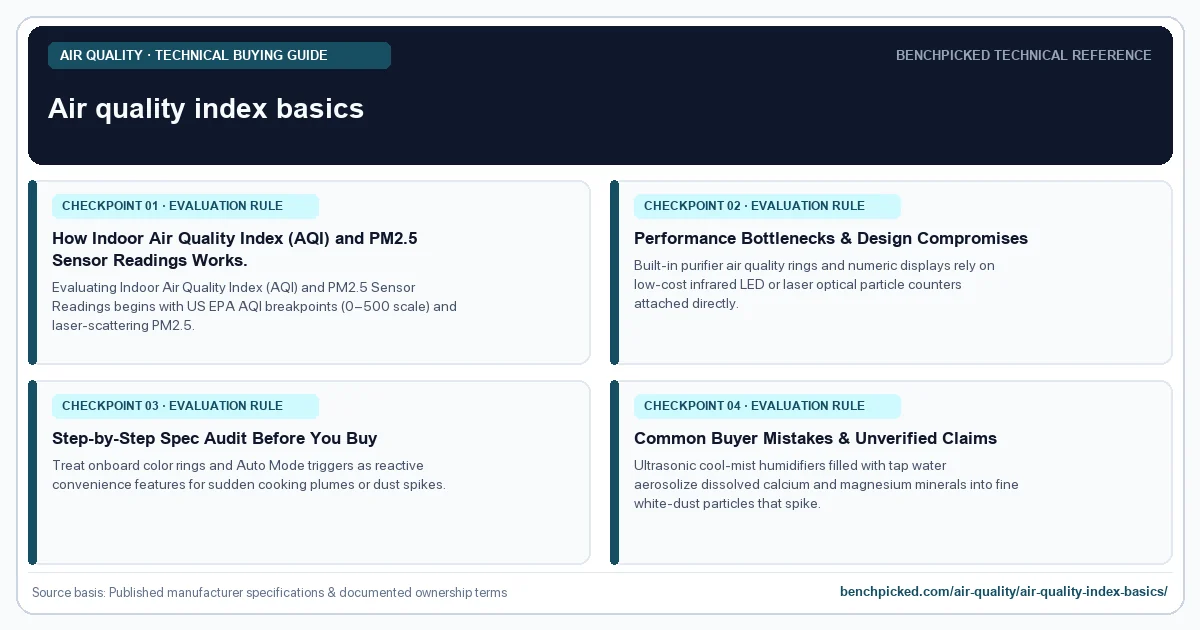
Evaluating Indoor Air Quality Index (AQI) and PM2.5 Sensor Readings begins with US EPA AQI breakpoints (0–500 scale) and laser-scattering PM2.5 microgram concentration (µg/m³), where accurate comparisons depend on PM2.5 mass concentration thresholds (0–9.0 µg/m³ Good under updated EPA standards) versus optical sensor limitations. The US EPA Air Quality Index translates raw pollutant concentrations into a 0–500 scale: 0–50 is Good, 51–100 is Moderate, 101–150 is Unhealthy for Sensitive Groups, and 151+ requires immediate high-speed filtration. For fine particulate matter (PM2.5), keeping indoor concentrations below 9 to 12 µg/m³ is the standard benchmark for clean residential air.
Performance Bottlenecks & Design Compromises
Built-in purifier air quality rings and numeric displays rely on low-cost infrared LED or laser optical particle counters attached directly to the purifier chassis. Because the sensor sits inches away from the clean exhaust stream, onboard AQI readings often drop to 'Good (Blue/Green)' long before the far corners of the bedroom have actually been cleared.
Step-by-Step Spec Audit Before You Buy
Treat onboard color rings and Auto Mode triggers as reactive convenience features for sudden cooking plumes or dust spikes, not precision room-wide instrumentation. If you manage severe asthma or wildfire smoke intrusion, place an independent PM2.5 monitor across the room and lock the purifier on a steady manual fan speed. Auditing step-by-step spec audit before you buy specifically for Air quality index basics keeps your comparison grounded in verified air quality index basics documentation rather than generic category assumptions.
Common Buyer Mistakes & Unverified Claims
Ultrasonic cool-mist humidifiers filled with tap water aerosolize dissolved calcium and magnesium minerals into fine white-dust particles that spike optical PM2.5 sensors past 200 µg/m³. Additionally, standard optical PM2.5 sensors cannot detect carbon monoxide, radon, carbon dioxide (CO2), or formaldehyde unless the unit includes a dedicated electrochemical or MOS gas sensor. Auditing common buyer mistakes & unverified claims specifically for Air quality index basics keeps your comparison grounded in verified air quality index basics documentation rather than generic category assumptions.
Applying Indoor Air Quality Index (AQI) and PM2.5 Sensor Readings Benchmarks to Your Shortlist
To put Indoor Air Quality Index (AQI) and PM2.5 Sensor Readings into practice across options like A higher-CADR purifier, A quieter compact purifier, and Source control or ventilation, log each candidate's published PM2.5 mass concentration thresholds (0–9.0 µg/m³ Good under updated EPA standards) versus optical sensor limitations alongside its warranty scope and return policy. Ranking hardware by verified US EPA AQI breakpoints (0–500 scale) and laser-scattering PM2.5 microgram concentration (µg/m³) capacity per dollar—rather than promotional feature count—prevents undersized purchases and unexpected maintenance expenses over a 36-month ownership cycle.
Full source-attributed specification record (0 fields)
Source notes
- EPA Guide To Air Cleaners In The Home · Government · Checked May 16, 2026
- AHAM Verifide Room Air Cleaner Directory · Industry Standard · Checked May 16, 2026
Questions
Which specific numbers matter most when evaluating Indoor Air Quality Index (AQI) and PM2.5 Sensor Readings?
When auditing Indoor Air Quality Index (AQI) and PM2.5 Sensor Readings, prioritize PM2.5 mass concentration thresholds (0–9.0 µg/m³ Good under updated EPA standards) versus optical sensor limitations measured under standardized US EPA AQI breakpoints (0–500 scale) and laser-scattering PM2.5 microgram concentration (µg/m³) test conditions. Recording those exact baseline figures for Indoor Air Quality Index (AQI) and PM2.5 Sensor Readings lets you size hardware accurately without relying on peak promotional claims.
What design tradeoffs affect real-world Indoor Air Quality Index (AQI) and PM2.5 Sensor Readings performance?
Every product in US EPA AQI breakpoints (0–500 scale) and laser-scattering PM2.5 microgram concentration (µg/m³) balances PM2.5 mass concentration thresholds (0–9.0 µg/m³ Good under updated EPA standards) versus optical sensor limitations against physical size, acoustic output, and power or consumable draw. Pushing one variable higher in Indoor Air Quality Index (AQI) and PM2.5 Sensor Readings—such as compact housing or ultra-quiet sleep operation—inevitably requires a tradeoff in peak throughput or runtime.
How should I verify Indoor Air Quality Index (AQI) and PM2.5 Sensor Readings claims before ordering?
To verify Indoor Air Quality Index (AQI) and PM2.5 Sensor Readings before checkout, cross-check the manufacturer's engineering spec sheet for PM2.5 mass concentration thresholds (0–9.0 µg/m³ Good under updated EPA standards) versus optical sensor limitations and confirm replacement part or subscription pricing. If a listing omits verifiable US EPA AQI breakpoints (0–500 scale) and laser-scattering PM2.5 microgram concentration (µg/m³) disclosures for Indoor Air Quality Index (AQI) and PM2.5 Sensor Readings, treat that missing parameter as a hard operating limit.
Which models or benchmarks are best for comparing Indoor Air Quality Index (AQI) and PM2.5 Sensor Readings?
For a transparent Indoor Air Quality Index (AQI) and PM2.5 Sensor Readings comparison in US EPA AQI breakpoints (0–500 scale) and laser-scattering PM2.5 microgram concentration (µg/m³), benchmark your shortlist against A higher-CADR purifier, A quieter compact purifier, and Source control or ventilation. Compare each Indoor Air Quality Index (AQI) and PM2.5 Sensor Readings candidate across PM2.5 mass concentration thresholds (0–9.0 µg/m³ Good under updated EPA standards) versus optical sensor limitations, 3-year consumable or membership cost, and open-box return coverage before buying.
Before you buy
Recheck fit and current terms
Compare Levoit Core 300S: CADR, Room Fit, Noise, and Filter Costs with the criteria on this page, then confirm the current seller terms.
How BenchPicked separates published facts, analysis, and evidence limits