Utility Gadgets research
Utility gadget buying criteria
Define the task and operating constraints first. Compare the complete purchase path. Test the dependency chain on paper. Example: trace one task through every dependency.
Written by BenchPicked Editorial Team · Sources checked Sep 15, 2026
Executive Summary
Bottom line
Everyday Utility & EDC Gadget Buying Criteria defines portable lighting, optical scopes, key/item trackers, and multi-function field tools by quantifying ANSI/PLATO FL1 lumen/runtime curves, optical vs digital magnification, and IPX ingress protection. Use verified Everyday Utility & EDC Gadget Buying Criteria calculations, hardware tradeoff rules, and 3-year consumable math to compare models such as A phone application, A documented competing device, and No dedicated device.
- Best Suited For
- people comparing a portable gadget for a specific travel or communication task
- Core Buying Check
- use utility gadget buying criteria to make a product decision without overreading promotional claims
- Key Evaluation Context
- checking connectivity, compatibility, power, data access and recurring cost
Decision matrix
Compare each documented specification against your room, routine, or operating requirements before checking live prices.
| Evaluation Factor | Documented Spec / Status | Buyer Takeaway |
|---|---|---|
| Primary engineering metric | ANSI/PLATO FL1 lumen/runtime curves, optical vs digital magnification, and IPX ingress protection | Use ANSI/PLATO FL1 lumen/runtime curves, optical vs digital magnification, and IPX ingress protection as your primary filter when sizing options in portable lighting, optical scopes, key/item trackers, and multi-function field tools. |
| Sizing & calculation rule | Evaluate portable utility gear against standardized engineering metrics rather than marketing superlatives: ANSI/PLATO FL1 sustained lumens and beam distance (meters) for flashlights, true optical glass magnification × objective lens diameter in millimeters (e. | Apply this formula to raw spec-sheet numbers rather than headline marketing banners. |
| 3-year ownership check | Hardware + consumables + power/subscriptions | Cross-check recurring filters, batteries, or membership fees across a phone application and competitors. |
Claim and evidence record
All 1 structured specification claims on this page are cross-referenced against the primary records listed below. Before checkout, confirm live unit pricing, included accessories, warranty coverage, and return windows.
When another option is the better fit
A phone application
Choose this when the phone, network and privacy trade-offs are acceptable.
A documented competing device
Choose this when offline use or language coverage is essential.
No dedicated device
Choose this when the task is occasional and existing tools already cover it.
Product example
Apply these criteria to Ryoko Pro
Use this approved product option as a concrete example while applying the criteria on this page. Confirm its published specifications and current seller terms before ordering.
Read the product researchCompare tested models: Enence Instant TranslatorKeilini TalkEaseRadPaws LED Dog Harness
Research details
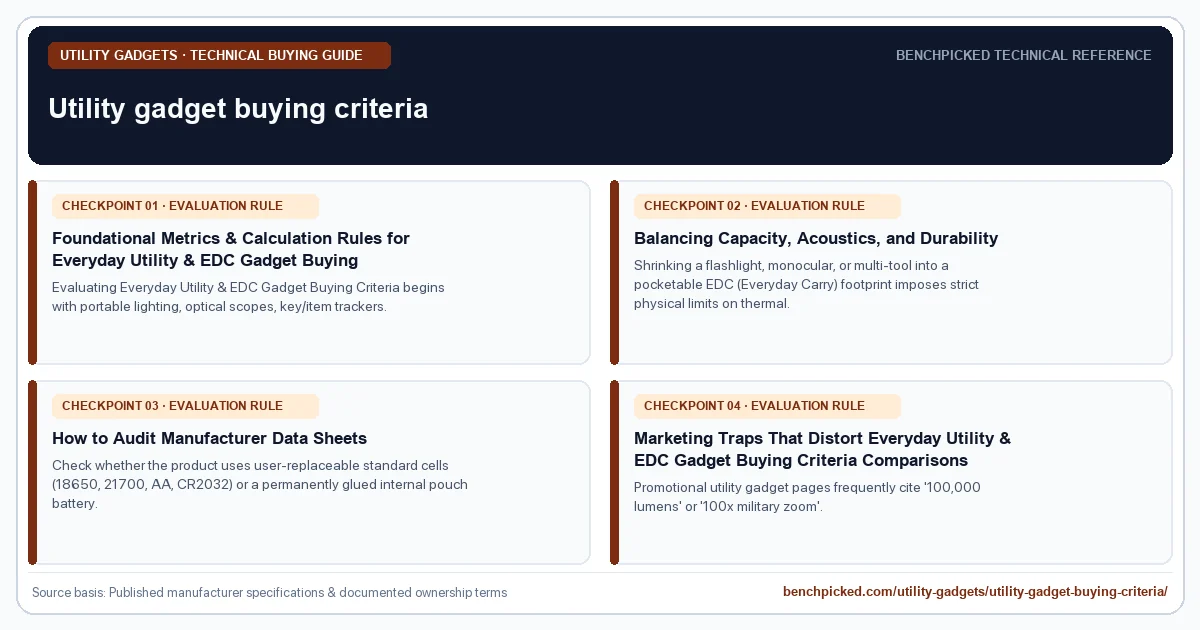
Foundational Metrics & Calculation Rules for Everyday Utility & EDC Gadget Buying Criteria
Evaluating Everyday Utility & EDC Gadget Buying Criteria begins with portable lighting, optical scopes, key/item trackers, and multi-function field tools, where accurate comparisons depend on ANSI/PLATO FL1 lumen/runtime curves, optical vs digital magnification, and IPX ingress protection. Evaluate portable utility gear against standardized engineering metrics rather than marketing superlatives: ANSI/PLATO FL1 sustained lumens and beam distance (meters) for flashlights, true optical glass magnification × objective lens diameter in millimeters (e.g., 10×42 or 12×50) for monoculars, and watt-hours (Wh = Voltage × Amp-hours) for internal lithium-ion batteries.
Balancing Capacity, Acoustics, and Durability
Shrinking a flashlight, monocular, or multi-tool into a pocketable EDC (Everyday Carry) footprint imposes strict physical limits on thermal dissipation, optical light gathering, and battery capacity. A pocket flashlight driven at a high burst output will step down thermally within 60 to 120 seconds to protect its LED emitter and battery, and a pocket monocular with a small objective lens cannot match the low-light exit pupil of full-size binoculars.
How to Audit Manufacturer Data Sheets
Check whether the product uses user-replaceable standard cells (18650, 21700, AA, CR2032) or a permanently glued internal pouch battery, and verify USB-C charging port compatibility. Require concrete chassis material disclosures (e.g., 6061-T6 anodized aluminum vs ABS plastic) and explicit IPX4–IP68 water-resistance ratings before using gear outdoors. Auditing how to audit manufacturer data sheets specifically for Utility gadget buying criteria keeps your comparison grounded in verified utility gadget buying criteria documentation rather than generic category assumptions.
Marketing Traps That Distort Everyday Utility & EDC Gadget Buying Criteria Comparisons
Promotional utility gadget pages frequently cite '100,000 lumens' or '100x military zoom'—figures that violate basic LED thermal physics and optical aperture limits for handheld consumer gear. Treat any tactical or optical gadget lacking a published battery capacity (mAh/Wh), exact dimensions/weight, and objective lens diameter in millimeters as a low-cost novelty item. Auditing marketing traps that distort everyday utility & edc gadget buying criteria comparisons specifically for Utility gadget buying criteria keeps your comparison grounded in verified utility gadget buying criteria documentation rather than generic category assumptions.
Practical Checklist for Final Model Selection
A disciplined shortlist built around Everyday Utility & EDC Gadget Buying Criteria compares A phone application, A documented competing device, and No dedicated device strictly on documented ANSI/PLATO FL1 lumen/runtime curves, optical vs digital magnification, and IPX ingress protection. Whenever a seller omits key portable lighting, optical scopes, key/item trackers, and multi-function field tools test conditions, treat that gap as a limiting factor and favor transparent manufacturers that publish complete engineering tables and spare-part pricing.
Full source-attributed specification record (0 fields)
Source notes
- FTC Online Shopping Guidance · Government · Checked Sep 15, 2026
- FTC Guidance On Free Trials And Auto Renewals · Government · Checked Sep 15, 2026
Questions
Which specific numbers matter most when evaluating Everyday Utility & EDC Gadget Buying Criteria?
When auditing Everyday Utility & EDC Gadget Buying Criteria, prioritize ANSI/PLATO FL1 lumen/runtime curves, optical vs digital magnification, and IPX ingress protection measured under standardized portable lighting, optical scopes, key/item trackers, and multi-function field tools test conditions. Recording those exact baseline figures for Everyday Utility & EDC Gadget Buying Criteria lets you size hardware accurately without relying on peak promotional claims.
What design tradeoffs affect real-world Everyday Utility & EDC Gadget Buying Criteria performance?
Every product in portable lighting, optical scopes, key/item trackers, and multi-function field tools balances ANSI/PLATO FL1 lumen/runtime curves, optical vs digital magnification, and IPX ingress protection against physical size, acoustic output, and power or consumable draw. Pushing one variable higher in Everyday Utility & EDC Gadget Buying Criteria—such as compact housing or ultra-quiet sleep operation—inevitably requires a tradeoff in peak throughput or runtime.
How should I verify Everyday Utility & EDC Gadget Buying Criteria claims before ordering?
To verify Everyday Utility & EDC Gadget Buying Criteria before checkout, cross-check the manufacturer's engineering spec sheet for ANSI/PLATO FL1 lumen/runtime curves, optical vs digital magnification, and IPX ingress protection and confirm replacement part or subscription pricing. If a listing omits verifiable portable lighting, optical scopes, key/item trackers, and multi-function field tools disclosures for Everyday Utility & EDC Gadget Buying Criteria, treat that missing parameter as a hard operating limit.
Which models or benchmarks are best for comparing Everyday Utility & EDC Gadget Buying Criteria?
For a transparent Everyday Utility & EDC Gadget Buying Criteria comparison in portable lighting, optical scopes, key/item trackers, and multi-function field tools, benchmark your shortlist against A phone application, A documented competing device, and No dedicated device. Compare each Everyday Utility & EDC Gadget Buying Criteria candidate across ANSI/PLATO FL1 lumen/runtime curves, optical vs digital magnification, and IPX ingress protection, 3-year consumable or membership cost, and open-box return coverage before buying.
Before you buy
Recheck fit and current terms
Compare Ryoko Pro with the criteria on this page, then confirm the current seller terms.
How BenchPicked separates published facts, analysis, and evidence limits