Sleep Tech research
Wearable vs Non-Wearable Sleep Trackers: Rings, Watches & Pads
Compare wearable smart rings and watches against non-wearable under-mattress BCG pads and bedside sleep systems across comfort, HRV accuracy, and nightly compliance.
Written by BenchPicked Editorial Team · Sources checked May 16, 2026
Executive Summary
Bottom line
Choose between wearable and non-wearable sleep trackers based on overnight skin comfort, travel frequency, and whether you need continuous 24/7 HRV/activity context. Smart rings (/sleep-tech/oura-ring-4/, /sleep-tech/samsung-galaxy-ring/) and watches (/sleep-tech/garmin-venu-3/) travel anywhere and isolate individual physiology in shared beds, while under-mattress pads (/sleep-tech/withings-sleep-analyzer/) and bed climate systems (/sleep-tech/bedjet-3/) require zero nightly charging or on-body wear.
- Best Suited For
- people comparing consumer sleep tracking without treating a wellness device as medical equipment
- Core Buying Check
- Choose between wearable sleep trackers (smart rings, watches, bands) and non-wearable bedroom hardware (under-mattress BCG pads, bedside alarms, active bed climate systems).
- Key Evaluation Context
- balancing comfort, sensors, charging, subscription cost and data access
Decision matrix
Compare each documented specification against your room, routine, or operating requirements before checking live prices.
| Evaluation Factor | Documented Spec / Status | Buyer Takeaway |
|---|---|---|
| Nightly Compliance & Charging Friction | AC plug-in zero-touch operation vs. 1.5-to-14 day wearable battery cycles | Choose AC-powered under-mattress sensors if you forget to charge wearables, or 7–14 day wearables for continuous tracking. |
| Shared-Bed Isolation & Travel Portability | On-body personal optical PPG vs. single-mattress-zone pneumatic pad | Wearables isolate your exact pulse regardless of partner movement or hotel beds; under-mattress pads stay anchored to one home mattress. |
| 3-Year Total Ownership Cost | Hardware + recurring app subscriptions ($0/mo vs. $5.99–$30/mo) | Compare subscription-free options against paid-membership wearables. |
Claim and evidence record
All 1 structured specification claims on this page are cross-referenced against the primary records listed below. Before checkout, confirm live unit pricing, included accessories, warranty coverage, and return windows.
When another option is the better fit
Oura Ring 4 (finger-PPG smart ring)
Choose this when you travel frequently or share a shifting mattress where an under-mattress pneumatic pad is harder to isolate.
Garmin Venu 3 (subscription-free smartwatch)
Choose this when you want 24/7 heart rate, daytime workouts, and nocturnal HRV alongside $0/mo sleep tracking.
BedJet 3 (active bed cooling & warming system)
Choose this when your primary sleep issue is night sweats or cold feet rather than passive sleep stage logging.
Product example
Apply these criteria to Herz P1 Smart Ring
A seller-listed smart ring option at $59.99 upfront with no mandatory monthly subscription (unlike $5.99/mo smart-ring memberships), advertised iOS/Android app sync, and up to six days of battery life. Confirm ring sizing, app access, and current purchase terms before ordering.
Read the product researchCompare tested models: Oura Ring 4Garmin Venu 3WHOOP 5.0Withings Sleep Analyzer
Research details
Defining Wearable vs Non-Wearable Sleep Tracking Architectures: Standards, Units & Baselines
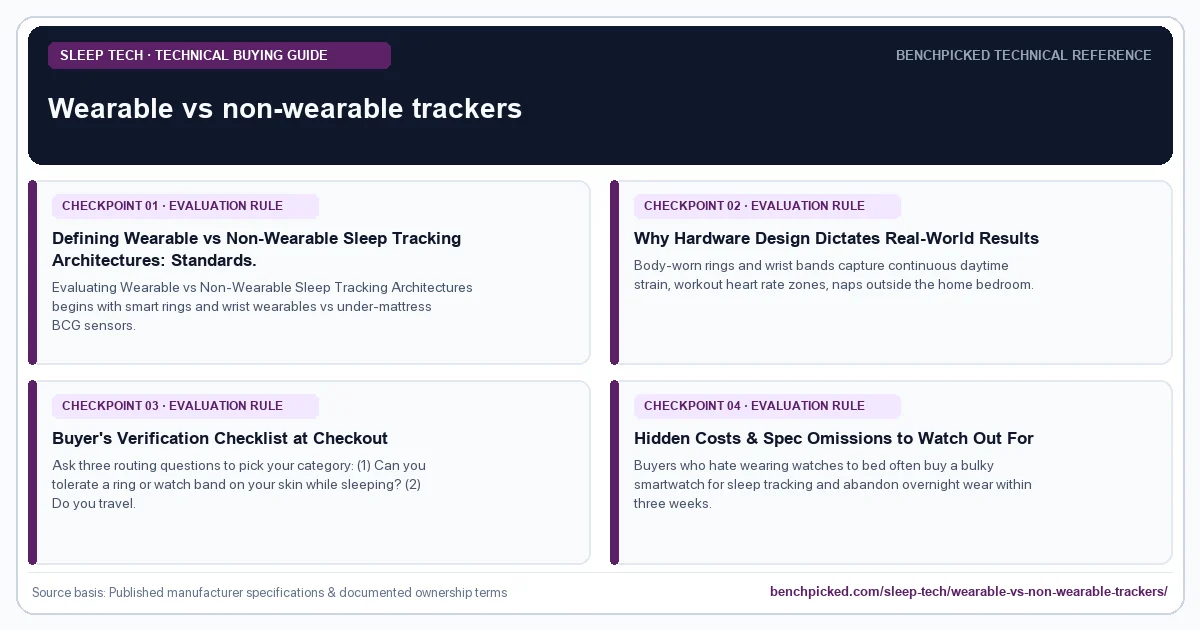
Evaluating Wearable vs Non-Wearable Sleep Tracking Architectures begins with smart rings and wrist wearables vs under-mattress BCG sensors and bedside environmental systems, where accurate comparisons depend on zero-touch compliance vs continuous 24/7 activity/HRV context, travel portability, and dual-sleeper separation. The best sleep tracker is the one with 100% nightly compliance over 365 days: a sensor sitting on a charger or left on the nightstand captures zero data. Wearables (rings, straps, watches) require active charging cadences and physical contact on skin, whereas under-mattress sensors and active bed climate systems stay plugged into wall power and operate automatically every time you lie down.
Why Hardware Design Dictates Real-World Results
Body-worn rings and wrist bands capture continuous daytime strain, workout heart rate zones, naps outside the home bedroom, and hotel travel nights seamlessly, giving their recovery algorithms full 24-hour context. Non-wearable under-mattress pads sacrifice daytime step/workout tracking and hotel convenience, but deliver effortless multi-year sleep logging with zero battery anxiety, zero wrist irritation, and automatic Wi-Fi cloud sync.
Buyer's Verification Checklist at Checkout
Ask three routing questions to pick your category: (1) Can you tolerate a ring or watch band on your skin while sleeping? (2) Do you travel frequently and want tracking away from your primary bed? (3) Are you trying to measure sleep biometrics (ring/watch/mattress pad) or actively modify the bedroom environment via forced-air bed cooling (BedJet) or sunrise audio routines (Hatch)?
Hidden Costs & Spec Omissions to Watch Out For
Buyers who hate wearing watches to bed often buy a bulky smartwatch for sleep tracking and abandon overnight wear within three weeks. Conversely, buyers who sleep in different beds several nights a week or share a narrow mattress with large pets that jump onto the sensor zone may see false bed-presence epochs on an under-mattress pad.
Comparing Smart Rings, Wrist Wearables, Under-Mattress Pads, and Bed Climate Systems
If you want personal HRV, skin temperature, and sleep staging that travels with you, compare finger rings such as Oura Ring 4 and Samsung Galaxy Ring against subscription-free watches such as Garmin Venu 3. If wearing a device on your fingers or wrists disturbs your sleep, non-wearable bedroom hardware splits into two clear roles: under-mattress sensors like Withings Sleep Analyzer for passive Wi-Fi sleep and breathing logs, and active thermal systems like BedJet 3 or Hatch Restore 2 for fixing the bedroom environment itself.
Full source-attributed specification record (0 fields)
Source notes
- FCC Equipment Authorization Database · Regulatory · Checked May 16, 2026
- Apple Health And Fitness Developer Documentation · Platform Documentation · Checked May 16, 2026
- Android Health Connect Documentation · Platform Documentation · Checked May 16, 2026
Questions
Which specific numbers matter most when evaluating Wearable vs Non-Wearable Sleep Tracking Architectures?
When auditing Wearable vs Non-Wearable Sleep Tracking Architectures, prioritize zero-touch compliance vs continuous 24/7 activity/HRV context, travel portability, and dual-sleeper separation measured under standardized smart rings and wrist wearables vs under-mattress BCG sensors and bedside environmental systems test conditions. Recording those exact baseline figures for Wearable vs Non-Wearable Sleep Tracking Architectures lets you size hardware accurately without relying on peak promotional claims.
What design tradeoffs affect real-world Wearable vs Non-Wearable Sleep Tracking Architectures performance?
Every product in smart rings and wrist wearables vs under-mattress BCG sensors and bedside environmental systems balances zero-touch compliance vs continuous 24/7 activity/HRV context, travel portability, and dual-sleeper separation against physical size, acoustic output, and power or consumable draw. Pushing one variable higher in Wearable vs Non-Wearable Sleep Tracking Architectures—such as compact housing or ultra-quiet sleep operation—inevitably requires a tradeoff in peak throughput or runtime.
How should I verify Wearable vs Non-Wearable Sleep Tracking Architectures claims before ordering?
To verify Wearable vs Non-Wearable Sleep Tracking Architectures before checkout, cross-check the manufacturer's engineering spec sheet for zero-touch compliance vs continuous 24/7 activity/HRV context, travel portability, and dual-sleeper separation and confirm replacement part or subscription pricing. If a listing omits verifiable smart rings and wrist wearables vs under-mattress BCG sensors and bedside environmental systems disclosures for Wearable vs Non-Wearable Sleep Tracking Architectures, treat that missing parameter as a hard operating limit.
When is a non-wearable sleep tracker better than a smart ring or watch?
An under-mattress pad like Withings Sleep Analyzer is the better fit when wrist straps or rings feel uncomfortable in bed or when you want plug-and-forget Wi-Fi tracking with $0 monthly fees; a wearable ring or watch is better when you travel often or want 24/7 HRV and workout recovery data.
Before you buy
Recheck fit and current terms
Compare Herz P1 Smart Ring with the criteria on this page, then confirm the current seller terms.
How BenchPicked separates published facts, analysis, and evidence limits