Sleep Tech research
Sleep Score Explained: HRV, Staging Weights & Readiness Math
How consumer sleep scores work: compare proprietary weighting of total sleep duration, REM/deep stage ratios, nocturnal RHR/HRV baselines, and restlessness penalties.
Written by BenchPicked Editorial Team · Sources checked May 16, 2026
Executive Summary
Bottom line
A consumer sleep score (0–100) is a weighted composite index—not a clinical polysomnography grade—that combines total time asleep, sleep efficiency, REM/deep stage ratios, and autonomic recovery signals (resting heart rate and HRV relative to your rolling 14-to-60 day baseline). Because Oura, WHOOP, Garmin, and Fitbit weight HRV vs. duration differently, compare long-term trends within one platform rather than comparing raw 0–100 numbers across brands.
- Best Suited For
- people comparing consumer sleep tracking without treating a wellness device as medical equipment
- Core Buying Check
- Understand how consumer sleep trackers calculate a 0–100 sleep or readiness score from duration, sleep stages, nocturnal RHR/HRV baselines, and wake interruptions.
- Key Evaluation Context
- balancing comfort, sensors, charging, subscription cost and data access
Decision matrix
Compare each documented specification against your room, routine, or operating requirements before checking live prices.
| Evaluation Factor | Documented Spec / Status | Buyer Takeaway |
|---|---|---|
| Duration & Efficiency vs. Autonomic Recovery (HRV/RHR) | Time-asleep weighting vs. nocturnal RMSSD heart-rate variability weighting | Check whether the platform separates its Sleep Score from its Readiness/Recovery Score or blends them into a single daily coach. |
| Personal Rolling Baseline Calibration | 7-to-30 night personal HRV and skin temperature baseline window | Expect composite readiness and sleep scores to stabilize only after 2–4 weeks of consistent nightly wear. |
| Paywall Access to Score Breakdowns | Subscription-gated sub-scores ($5.99/mo+) vs. subscription-free contributor charts ($0/mo) | Verify whether detailed score contributors require a monthly membership. |
Claim and evidence record
All 1 structured specification claims on this page are cross-referenced against the primary records listed below. Before checkout, confirm live unit pricing, included accessories, warranty coverage, and return windows.
When another option is the better fit
Garmin Venu 3 (subscription-free recovery & sleep watch)
Choose this when you want nocturnal HRV status, sleep coaching, and workout recovery metrics without a mandatory annual membership.
Oura Ring 4 (finger-PPG smart ring)
Choose this when you prefer a low-profile titanium finger ring over a tight wrist or bicep strap overnight.
Withings Sleep Analyzer (under-mattress BCG pad)
Choose this when you want zero-wearable nightly sleep staging and breathing disturbance tracking under the mattress.
Product example
Apply these criteria to Herz P1 Smart Ring
A seller-listed smart ring option at $59.99 upfront with no mandatory monthly subscription (unlike $5.99/mo smart-ring memberships), advertised iOS/Android app sync, and up to six days of battery life. Confirm ring sizing, app access, and current purchase terms before ordering.
Read the product researchCompare tested models: Oura Ring 4Garmin Venu 3WHOOP 5.0Withings Sleep Analyzer
Research details
Foundational Metrics & Calculation Rules for How Consumer Sleep Scores and Readiness Algorithms Work
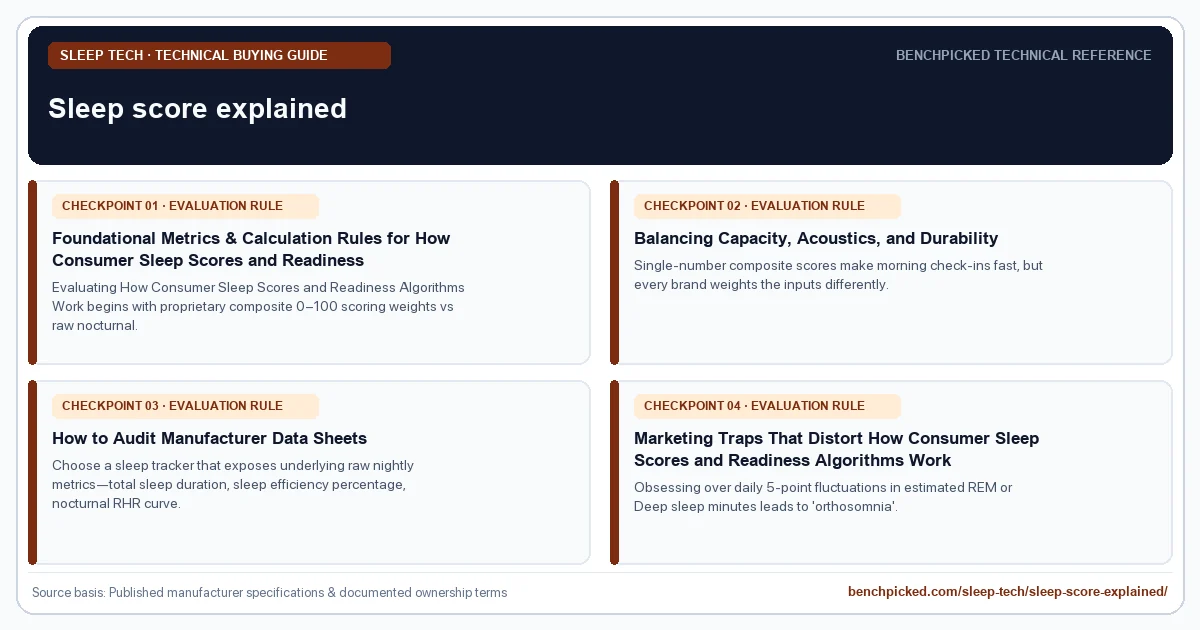
Evaluating How Consumer Sleep Scores and Readiness Algorithms Work begins with proprietary composite 0–100 scoring weights vs raw nocturnal physiological baselines, where accurate comparisons depend on sleep duration, sleep efficiency (time asleep / time in bed), restfulness, latency, and nocturnal RHR/HRV recovery. A consumer 'Sleep Score' (0–100) is a weighted algorithmic summary combining two distinct buckets: sleep continuity metrics (total time asleep, time in bed, wake after sleep onset, onset latency) and autonomic recovery signals (how quickly resting heart rate drops to its nightly nadir and how nocturnal HRV compares against your rolling 14-to-60-day personal baseline).
Balancing Capacity, Acoustics, and Durability
Single-number composite scores make morning check-ins fast, but every brand weights the inputs differently: one platform may penalize a late bedtime heavily due to circadian alignment rules, while another weights deep/REM stage duration or HRV rebound more strongly. Wearing two trackers on the same night routinely produces sleep scores that differ by 8 to 15 points and stage minutes that diverge by 25%, even when both devices record the exact same 52 bpm resting heart rate.
How to Audit Manufacturer Data Sheets
Choose a sleep tracker that exposes underlying raw nightly metrics—total sleep duration, sleep efficiency percentage, nocturnal RHR curve, HRV in milliseconds, respiratory rate, and skin temperature deviation—rather than hiding data behind a single opaque score. Give any new tracker 14 to 21 consecutive nights to calibrate your personal physiological baseline before acting on its recovery recommendations.
Marketing Traps That Distort How Consumer Sleep Scores and Readiness Algorithms Work Comparisons
Obsessing over daily 5-point fluctuations in estimated REM or Deep sleep minutes leads to 'orthosomnia'—anxiety caused by chasing a perfect tracker score that ironically disrupts natural sleep onset. Focus on controllable multi-week behavioral trends: consistent wake times, alcohol/late-meal impact on nocturnal heart rate, and total time in bed. Treating your sleep tracker as a long-term baseline compass rather than a single-night grade prevents unnecessary sleep anxiety.
How Oura, WHOOP, Garmin, and Withings Weight Sleep Score Contributors
Each ecosystem tunes its 0–100 composite score for a slightly different audience: Oura Ring 4 separates nightly sleep architecture from an autonomic Readiness score anchored to nocturnal RHR, HRV, and temperature; WHOOP 5.0 weights recovery heavily toward HRV and sleep need relative to prior-day cardiovascular strain; and Garmin Venu 3 integrates stress, HRV status, and daytime naps into a subscription-free sleep coach. Because a single 0–100 badge can mask whether a low score came from late caffeine (elevated RHR) or a short sleep window, prioritize trackers that expose raw contributor trends without locking historical charts behind a paywall.
Full source-attributed specification record (0 fields)
Source notes
- FCC Equipment Authorization Database · Regulatory · Checked May 16, 2026
- Apple Health And Fitness Developer Documentation · Platform Documentation · Checked May 16, 2026
- Android Health Connect Documentation · Platform Documentation · Checked May 16, 2026
Questions
Which specific numbers matter most when evaluating How Consumer Sleep Scores and Readiness Algorithms Work?
When auditing How Consumer Sleep Scores and Readiness Algorithms Work, prioritize sleep duration, sleep efficiency (time asleep / time in bed), restfulness, latency, and nocturnal RHR/HRV recovery measured under standardized proprietary composite 0–100 scoring weights vs raw nocturnal physiological baselines test conditions. Recording those exact baseline figures for How Consumer Sleep Scores and Readiness Algorithms Work lets you size hardware accurately without relying on peak promotional claims.
What design tradeoffs affect real-world How Consumer Sleep Scores and Readiness Algorithms Work performance?
Every product in proprietary composite 0–100 scoring weights vs raw nocturnal physiological baselines balances sleep duration, sleep efficiency (time asleep / time in bed), restfulness, latency, and nocturnal RHR/HRV recovery against physical size, acoustic output, and power or consumable draw. Pushing one variable higher in How Consumer Sleep Scores and Readiness Algorithms Work—such as compact housing or ultra-quiet sleep operation—inevitably requires a tradeoff in peak throughput or runtime.
How should I verify How Consumer Sleep Scores and Readiness Algorithms Work claims before ordering?
To verify How Consumer Sleep Scores and Readiness Algorithms Work before checkout, cross-check the manufacturer's engineering spec sheet for sleep duration, sleep efficiency (time asleep / time in bed), restfulness, latency, and nocturnal RHR/HRV recovery and confirm replacement part or subscription pricing. If a listing omits verifiable proprietary composite 0–100 scoring weights vs raw nocturnal physiological baselines disclosures for How Consumer Sleep Scores and Readiness Algorithms Work, treat that missing parameter as a hard operating limit.
Why do two sleep trackers worn on the same night give different sleep scores?
Each brand uses proprietary stage-classification algorithms and different contributor weights: for example, WHOOP 5.0 and Oura Ring 4 weight nocturnal HRV and nadir heart rate differently from wristwatches like Garmin Venu 3. Track your personal rolling baseline on one consistent device rather than mixing cross-brand scores.
Before you buy
Recheck fit and current terms
Compare Herz P1 Smart Ring with the criteria on this page, then confirm the current seller terms.
How BenchPicked separates published facts, analysis, and evidence limits