Home Environment research
Portable AC vs air cooler
Identify the cooling mechanism. Match the installation to the room. Compare the complete operating system. Example: compare installation and climate before price.
Written by BenchPicked Editorial Team · Sources checked Sep 15, 2026
Executive Summary
Bottom line
Portable Air Conditioner vs Evaporative Air Cooler Architecture defines vapor-compression refrigeration cycle vs adiabatic water-evaporation cooling by quantifying refrigerant compressor + window exhaust hose vs wet honeycomb media pad + relative humidity (RH) ceiling. Use verified Portable Air Conditioner vs Evaporative Air Cooler Architecture calculations, hardware tradeoff rules, and 3-year consumable math to compare models such as A room air conditioner, An evaporative cooler, and A circulation fan.
- Best Suited For
- people choosing a cooling or comfort product for a specific room
- Core Buying Check
- use portable ac vs air cooler to make a product decision without overreading promotional claims
- Key Evaluation Context
- checking the cooling mechanism, room conditions, installation, noise and running cost
Decision matrix
Compare each documented specification against your room, routine, or operating requirements before checking live prices.
| Evaluation Factor | Documented Spec / Status | Buyer Takeaway |
|---|---|---|
| Primary engineering metric | refrigerant compressor + window exhaust hose vs wet honeycomb media pad + relative humidity (RH) ceiling | Use refrigerant compressor + window exhaust hose vs wet honeycomb media pad + relative humidity (RH) ceiling as your primary filter when sizing options in vapor-compression refrigeration cycle vs adiabatic water-evaporation cooling. |
| Sizing & calculation rule | A portable air conditioner uses a sealed refrigerant compressor to extract indoor heat and reject it outdoors through a 5-to-6-inch window exhaust hose, lowering both room temperature and relative humidity in any climate. | Apply this formula to raw spec-sheet numbers rather than headline marketing banners. |
| 3-year ownership check | Hardware + consumables + power/subscriptions | Cross-check recurring filters, batteries, or membership fees across a room air conditioner and competitors. |
Claim and evidence record
All 1 structured specification claims on this page are cross-referenced against the primary records listed below. Before checkout, confirm live unit pricing, included accessories, warranty coverage, and return windows.
When another option is the better fit
A room air conditioner
Choose this when documented cooling capacity and humidity control are required.
An evaporative cooler
Choose this when the climate is dry and added humidity is acceptable.
A circulation fan
Choose this when air movement, not temperature reduction, is the actual goal.
Product example
Apply these criteria to ChillWell 2.0
Use this approved product option as a concrete example while applying the criteria on this page. Confirm its published specifications and current seller terms before ordering.
Read the product researchCompare tested models: Glacier Breeze Portable ACBreeze BoxLevoit Classic 300S
Research details
Foundational Metrics & Calculation Rules for Portable Air Conditioner vs Evaporative Air Cooler Architecture
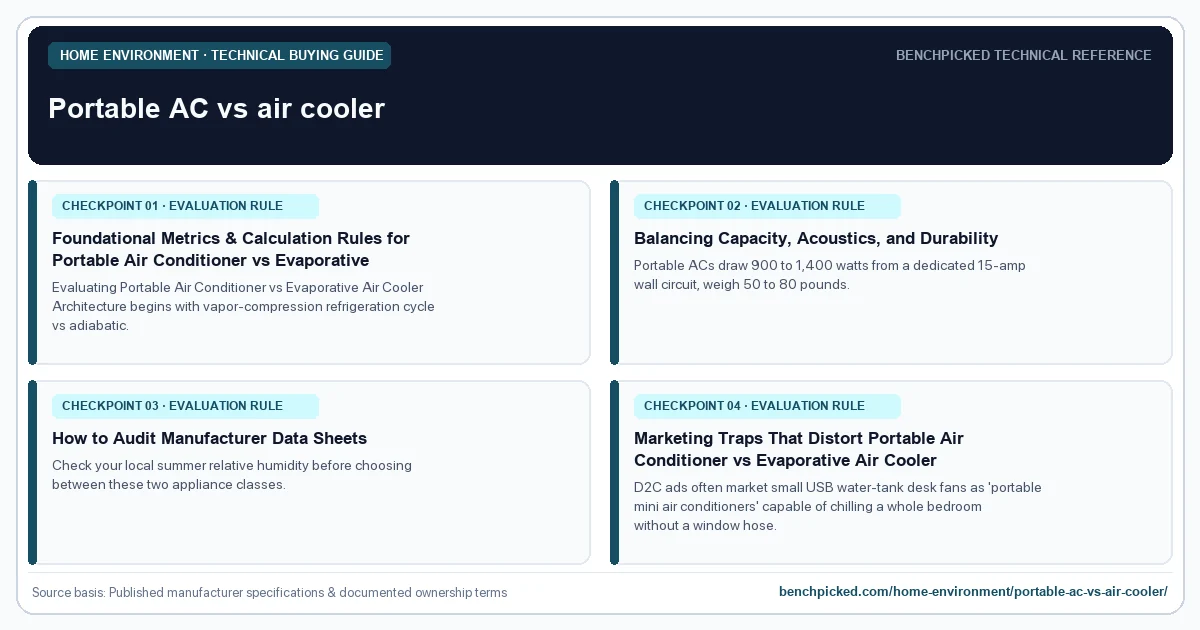
Evaluating Portable Air Conditioner vs Evaporative Air Cooler Architecture begins with vapor-compression refrigeration cycle vs adiabatic water-evaporation cooling, where accurate comparisons depend on refrigerant compressor + window exhaust hose vs wet honeycomb media pad + relative humidity (RH) ceiling. A portable air conditioner uses a sealed refrigerant compressor to extract indoor heat and reject it outdoors through a 5-to-6-inch window exhaust hose, lowering both room temperature and relative humidity in any climate. An evaporative air cooler (swamp cooler) has no compressor and no exhaust hose; it blows room air across water-soaked pads, dropping air temperature only when ambient relative humidity is below 35%–45%.
Balancing Capacity, Acoustics, and Durability
Portable ACs draw 900 to 1,400 watts from a dedicated 15-amp wall circuit, weigh 50 to 80 pounds, and require a sealed window kit plus condensate management. Evaporative coolers draw just 45 to 120 watts, weigh under 15 pounds, and roll freely without window hoses, but they actively add water vapor to indoor air—requiring a cracked window for cross-ventilation.
How to Audit Manufacturer Data Sheets
Check your local summer relative humidity before choosing between these two appliance classes. In humid coastal, Midwestern, or Eastern summers (RH above 50%), buy a true compressor-based AC or dehumidifier. Reserve hose-free evaporative coolers for arid desert climates (Southwest US) or localized desk/patio breeze where adding humidity is beneficial. Auditing how to audit manufacturer data sheets specifically for Portable AC vs air cooler keeps your comparison grounded in verified portable ac vs air cooler documentation rather than generic category assumptions.
Marketing Traps That Distort Portable Air Conditioner vs Evaporative Air Cooler Architecture Comparisons
D2C ads often market small USB water-tank desk fans as 'portable mini air conditioners' capable of chilling a whole bedroom without a window hose. Running an evaporative water cooler inside a closed, humid bedroom quickly saturates the air past 70% RH, stopping evaporative heat transfer completely and making the room feel hotter and muggier than a dry fan.
Practical Checklist for Final Model Selection
A disciplined shortlist built around Portable Air Conditioner vs Evaporative Air Cooler Architecture compares A room air conditioner, An evaporative cooler, and A circulation fan strictly on documented refrigerant compressor + window exhaust hose vs wet honeycomb media pad + relative humidity (RH) ceiling. Whenever a seller omits key vapor-compression refrigeration cycle vs adiabatic water-evaporation cooling test conditions, treat that gap as a limiting factor and favor transparent manufacturers that publish complete engineering tables and spare-part pricing.
Full source-attributed specification record (0 fields)
Source notes
- US Department Of Energy HVAC Guide · Government · Checked Sep 15, 2026
- ENERGY STAR Room Air Conditioner Sizing · Government · Checked Sep 15, 2026
Questions
Which specific numbers matter most when evaluating Portable Air Conditioner vs Evaporative Air Cooler Architecture?
When auditing Portable Air Conditioner vs Evaporative Air Cooler Architecture, prioritize refrigerant compressor + window exhaust hose vs wet honeycomb media pad + relative humidity (RH) ceiling measured under standardized vapor-compression refrigeration cycle vs adiabatic water-evaporation cooling test conditions. Recording those exact baseline figures for Portable Air Conditioner vs Evaporative Air Cooler Architecture lets you size hardware accurately without relying on peak promotional claims.
What design tradeoffs affect real-world Portable Air Conditioner vs Evaporative Air Cooler Architecture performance?
Every product in vapor-compression refrigeration cycle vs adiabatic water-evaporation cooling balances refrigerant compressor + window exhaust hose vs wet honeycomb media pad + relative humidity (RH) ceiling against physical size, acoustic output, and power or consumable draw. Pushing one variable higher in Portable Air Conditioner vs Evaporative Air Cooler Architecture—such as compact housing or ultra-quiet sleep operation—inevitably requires a tradeoff in peak throughput or runtime.
How should I verify Portable Air Conditioner vs Evaporative Air Cooler Architecture claims before ordering?
To verify Portable Air Conditioner vs Evaporative Air Cooler Architecture before checkout, cross-check the manufacturer's engineering spec sheet for refrigerant compressor + window exhaust hose vs wet honeycomb media pad + relative humidity (RH) ceiling and confirm replacement part or subscription pricing. If a listing omits verifiable vapor-compression refrigeration cycle vs adiabatic water-evaporation cooling disclosures for Portable Air Conditioner vs Evaporative Air Cooler Architecture, treat that missing parameter as a hard operating limit.
Which models or benchmarks are best for comparing Portable Air Conditioner vs Evaporative Air Cooler Architecture?
For a transparent Portable Air Conditioner vs Evaporative Air Cooler Architecture comparison in vapor-compression refrigeration cycle vs adiabatic water-evaporation cooling, benchmark your shortlist against A room air conditioner, An evaporative cooler, and A circulation fan. Compare each Portable Air Conditioner vs Evaporative Air Cooler Architecture candidate across refrigerant compressor + window exhaust hose vs wet honeycomb media pad + relative humidity (RH) ceiling, 3-year consumable or membership cost, and open-box return coverage before buying.
Before you buy
Recheck fit and current terms
Compare ChillWell 2.0 with the criteria on this page, then confirm the current seller terms.
How BenchPicked separates published facts, analysis, and evidence limits