Home Environment research
Noise and room size tradeoffs
Compare noise at a useful operating setting. Keep comfort requirements explicit. Create a like-for-like operating scenario. Example: keep quiet mode tied to useful output.
Written by BenchPicked Editorial Team · Sources checked Sep 15, 2026
Executive Summary
Bottom line
Cooling Appliance Acoustics and Room Size Tradeoffs defines compressor cycling rumble, blower airflow velocity, and dual-hose inverter acoustic curves by quantifying 42–56 dBA bedroom acoustic targets, fixed-speed vs inverter compressors, and throw distance. Use verified Cooling Appliance Acoustics and Room Size Tradeoffs calculations, hardware tradeoff rules, and 3-year consumable math to compare models such as A room air conditioner, An evaporative cooler, and A circulation fan.
- Best Suited For
- people choosing a cooling or comfort product for a specific room
- Core Buying Check
- use noise and room size tradeoffs to make a product decision without overreading promotional claims
- Key Evaluation Context
- checking the cooling mechanism, room conditions, installation, noise and running cost
Decision matrix
Compare each documented specification against your room, routine, or operating requirements before checking live prices.
| Evaluation Factor | Documented Spec / Status | Buyer Takeaway |
|---|---|---|
| Primary engineering metric | 42–56 dBA bedroom acoustic targets, fixed-speed vs inverter compressors, and throw distance | Use 42–56 dBA bedroom acoustic targets, fixed-speed vs inverter compressors, and throw distance as your primary filter when sizing options in compressor cycling rumble, blower airflow velocity, and dual-hose inverter acoustic curves. |
| Sizing & calculation rule | Unlike window air conditioners that hang the noisy compressor outside the building envelope, portable air conditioners house both the rotary compressor and two fans (evaporator and condenser) inside your living space. | Apply this formula to raw spec-sheet numbers rather than headline marketing banners. |
| 3-year ownership check | Hardware + consumables + power/subscriptions | Cross-check recurring filters, batteries, or membership fees across a room air conditioner and competitors. |
Claim and evidence record
All 1 structured specification claims on this page are cross-referenced against the primary records listed below. Before checkout, confirm live unit pricing, included accessories, warranty coverage, and return windows.
When another option is the better fit
A room air conditioner
Choose this when documented cooling capacity and humidity control are required.
An evaporative cooler
Choose this when the climate is dry and added humidity is acceptable.
A circulation fan
Choose this when air movement, not temperature reduction, is the actual goal.
Product example
Apply these criteria to ChillWell 2.0
Use this approved product option as a concrete example while applying the criteria on this page. Confirm its published specifications and current seller terms before ordering.
Read the product researchCompare tested models: Glacier Breeze Portable ACBreeze BoxLevoit Classic 300S
Research details
Defining Cooling Appliance Acoustics and Room Size Tradeoffs: Standards, Units & Baselines
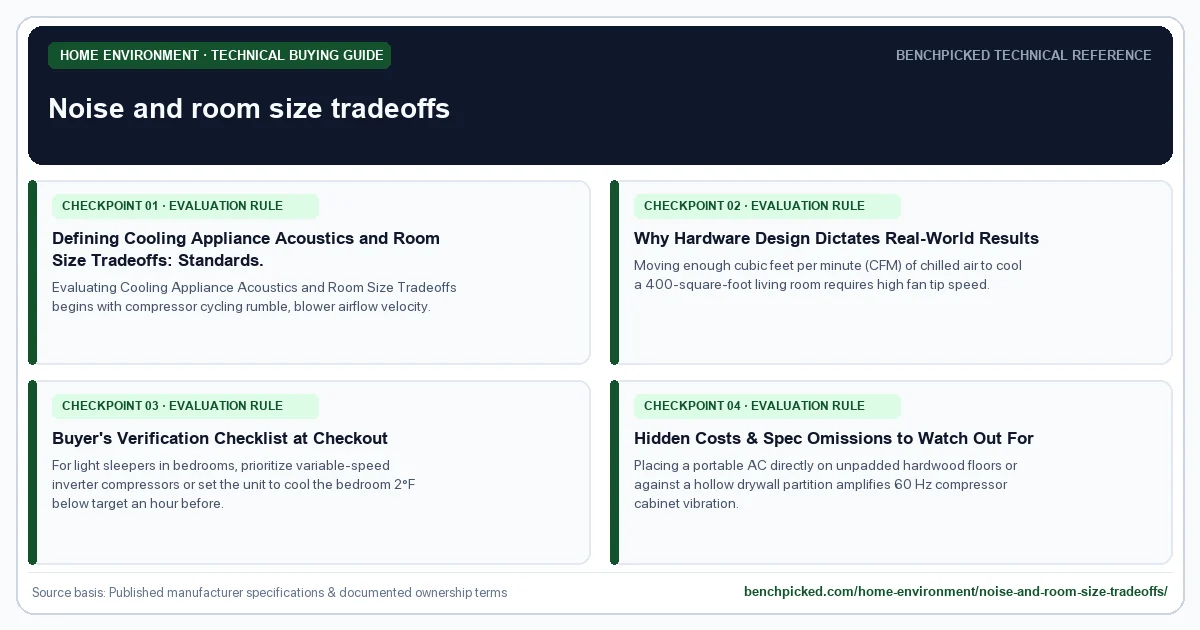
Evaluating Cooling Appliance Acoustics and Room Size Tradeoffs begins with compressor cycling rumble, blower airflow velocity, and dual-hose inverter acoustic curves, where accurate comparisons depend on 42–56 dBA bedroom acoustic targets, fixed-speed vs inverter compressors, and throw distance. Unlike window air conditioners that hang the noisy compressor outside the building envelope, portable air conditioners house both the rotary compressor and two fans (evaporator and condenser) inside your living space. A typical fixed-speed portable AC operates between 50 and 56 dBA, whereas variable-speed inverter dual-hose models can ramp down to 42–45 dBA once target temperature is reached.
Why Hardware Design Dictates Real-World Results
Moving enough cubic feet per minute (CFM) of chilled air to cool a 400-square-foot living room requires high fan tip speed, which generates aerodynamic grille noise above 52 dBA. However, fixed-speed compressors create a more disruptive sleep hazard than steady fan noise: the sudden 15 dB mechanical jolt and vibration every time the compressor clutches on at 3:00 AM.
Buyer's Verification Checklist at Checkout
For light sleepers in bedrooms, prioritize variable-speed inverter compressors or set the unit to cool the bedroom 2°F below target an hour before bedtime, then switch to low fan/sleep mode overnight. Verify that the spec sheet states the measurement distance (standard is 1 meter / 3.3 feet) and lists both low-fan and high-compressor decibel figures.
Hidden Costs & Spec Omissions to Watch Out For
Placing a portable AC directly on unpadded hardwood floors or against a hollow drywall partition amplifies 60 Hz compressor cabinet vibration throughout the bedroom; always set the casters on a dense neoprene anti-vibration mat. Also avoid kinking or over-extending the exhaust hose past 5 feet, which increases backpressure on the condenser fan and raises operating noise.
Turning Published Specs Into a 3-Year Decision
Before finalizing your purchase in compressor cycling rumble, blower airflow velocity, and dual-hose inverter acoustic curves, cross-reference 42–56 dBA bedroom acoustic targets, fixed-speed vs inverter compressors, and throw distance across established benchmarks such as A room air conditioner, An evaporative cooler, and A circulation fan. Combining upfront hardware price with multi-year operating inputs ensures your chosen configuration delivers reliable Cooling Appliance Acoustics and Room Size Tradeoffs performance without hidden post-purchase lock-in.
Full source-attributed specification record (0 fields)
Source notes
- ENERGY STAR Room Air Conditioner Sizing · Government · Checked Sep 15, 2026
- US Department Of Energy HVAC Guide · Government · Checked Sep 15, 2026
Questions
Which specific numbers matter most when evaluating Cooling Appliance Acoustics and Room Size Tradeoffs?
When auditing Cooling Appliance Acoustics and Room Size Tradeoffs, prioritize 42–56 dBA bedroom acoustic targets, fixed-speed vs inverter compressors, and throw distance measured under standardized compressor cycling rumble, blower airflow velocity, and dual-hose inverter acoustic curves test conditions. Recording those exact baseline figures for Cooling Appliance Acoustics and Room Size Tradeoffs lets you size hardware accurately without relying on peak promotional claims.
What design tradeoffs affect real-world Cooling Appliance Acoustics and Room Size Tradeoffs performance?
Every product in compressor cycling rumble, blower airflow velocity, and dual-hose inverter acoustic curves balances 42–56 dBA bedroom acoustic targets, fixed-speed vs inverter compressors, and throw distance against physical size, acoustic output, and power or consumable draw. Pushing one variable higher in Cooling Appliance Acoustics and Room Size Tradeoffs—such as compact housing or ultra-quiet sleep operation—inevitably requires a tradeoff in peak throughput or runtime.
How should I verify Cooling Appliance Acoustics and Room Size Tradeoffs claims before ordering?
To verify Cooling Appliance Acoustics and Room Size Tradeoffs before checkout, cross-check the manufacturer's engineering spec sheet for 42–56 dBA bedroom acoustic targets, fixed-speed vs inverter compressors, and throw distance and confirm replacement part or subscription pricing. If a listing omits verifiable compressor cycling rumble, blower airflow velocity, and dual-hose inverter acoustic curves disclosures for Cooling Appliance Acoustics and Room Size Tradeoffs, treat that missing parameter as a hard operating limit.
Which models or benchmarks are best for comparing Cooling Appliance Acoustics and Room Size Tradeoffs?
For a transparent Cooling Appliance Acoustics and Room Size Tradeoffs comparison in compressor cycling rumble, blower airflow velocity, and dual-hose inverter acoustic curves, benchmark your shortlist against A room air conditioner, An evaporative cooler, and A circulation fan. Compare each Cooling Appliance Acoustics and Room Size Tradeoffs candidate across 42–56 dBA bedroom acoustic targets, fixed-speed vs inverter compressors, and throw distance, 3-year consumable or membership cost, and open-box return coverage before buying.
Before you buy
Recheck fit and current terms
Compare ChillWell 2.0 with the criteria on this page, then confirm the current seller terms.
How BenchPicked separates published facts, analysis, and evidence limits