Home Environment research
Cooling coverage basics
Start with the space, not the advertised maximum. Compare equivalent ratings. Document the room and the stated test boundary. Example: reject a misleading room-size comparison.
Written by BenchPicked Editorial Team · Sources checked Sep 15, 2026
Executive Summary
Bottom line
Room Cooling Coverage Calculations and Thermal Load Sizing defines DOE SACC vs ASHRAE BTU/hr ratings and architectural heat-gain modifiers by quantifying floor square footage, ceiling height volume, solar exposure, and duct loss adjustment factors. Use verified Room Cooling Coverage Calculations and Thermal Load Sizing calculations, hardware tradeoff rules, and 3-year consumable math to compare models such as A room air conditioner, An evaporative cooler, and A circulation fan.
- Best Suited For
- people choosing a cooling or comfort product for a specific room
- Core Buying Check
- use cooling coverage basics to make a product decision without overreading promotional claims
- Key Evaluation Context
- checking the cooling mechanism, room conditions, installation, noise and running cost
Decision matrix
Compare each documented specification against your room, routine, or operating requirements before checking live prices.
| Evaluation Factor | Documented Spec / Status | Buyer Takeaway |
|---|---|---|
| Primary engineering metric | floor square footage, ceiling height volume, solar exposure, and duct loss adjustment factors | Use floor square footage, ceiling height volume, solar exposure, and duct loss adjustment factors as your primary filter when sizing options in DOE SACC vs ASHRAE BTU/hr ratings and architectural heat-gain modifiers. |
| Sizing & calculation rule | Start with true conditioned floor area (length × width in feet) under a standard 8-foot ceiling, where baseline portable cooling requires roughly 20 to 25 Seasonally Adjusted Cooling Capacity (SACC) BTU/hr per square foot. | Apply this formula to raw spec-sheet numbers rather than headline marketing banners. |
| 3-year ownership check | Hardware + consumables + power/subscriptions | Cross-check recurring filters, batteries, or membership fees across a room air conditioner and competitors. |
Claim and evidence record
All 1 structured specification claims on this page are cross-referenced against the primary records listed below. Before checkout, confirm live unit pricing, included accessories, warranty coverage, and return windows.
When another option is the better fit
A room air conditioner
Choose this when documented cooling capacity and humidity control are required.
An evaporative cooler
Choose this when the climate is dry and added humidity is acceptable.
A circulation fan
Choose this when air movement, not temperature reduction, is the actual goal.
Product example
Apply these criteria to ChillWell 2.0
Use this approved product option as a concrete example while applying the criteria on this page. Confirm its published specifications and current seller terms before ordering.
Read the product researchCompare tested models: Glacier Breeze Portable ACBreeze Box
Research details
How Room Cooling Coverage Calculations and Thermal Load Sizing Works: Core Physics & Measurement Rules
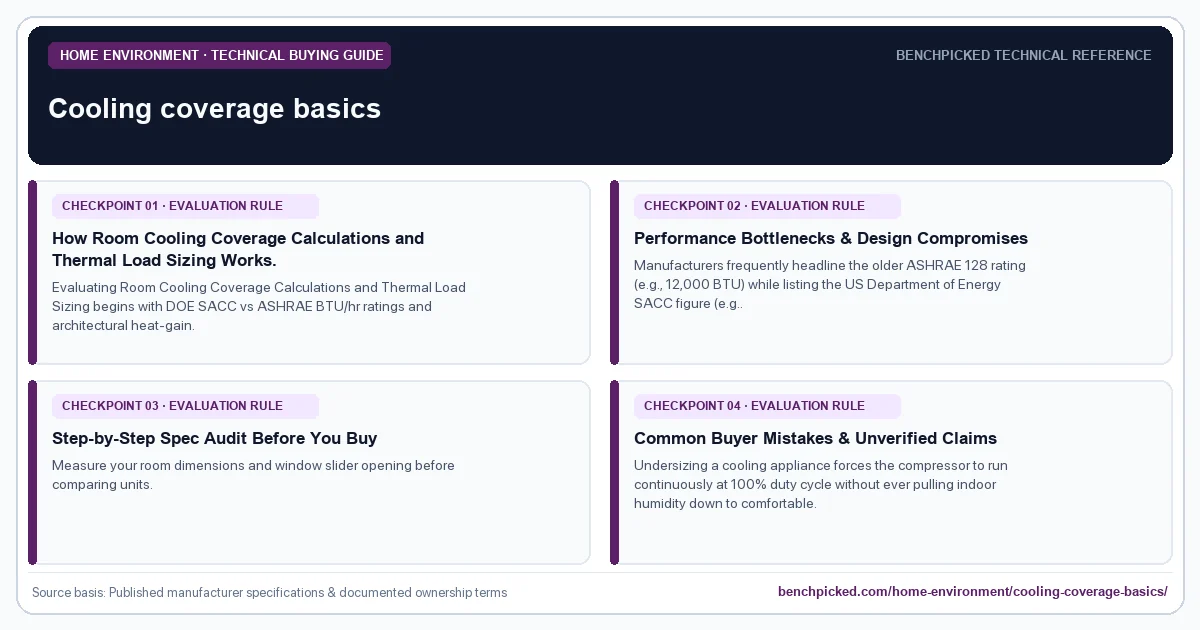
Evaluating Room Cooling Coverage Calculations and Thermal Load Sizing begins with DOE SACC vs ASHRAE BTU/hr ratings and architectural heat-gain modifiers, where accurate comparisons depend on floor square footage, ceiling height volume, solar exposure, and duct loss adjustment factors. Start with true conditioned floor area (length × width in feet) under a standard 8-foot ceiling, where baseline portable cooling requires roughly 20 to 25 Seasonally Adjusted Cooling Capacity (SACC) BTU/hr per square foot. Apply thermal load multipliers: add 10%–15% for south- or west-facing glass, add 15%–20% for ceiling heights above 9 feet, and add 600 BTU/hr per additional occupant or heat-generating workstation.
Performance Bottlenecks & Design Compromises
Manufacturers frequently headline the older ASHRAE 128 rating (e.g., 12,000 BTU) while listing the US Department of Energy SACC figure (e.g., 7,500–8,200 BTU) in smaller print. Because SACC accounts for warm makeup air pulled into the home by single-hose exhaust pressure and radiant heat from the exhaust duct itself, only the SACC number reflects net sensible cooling delivered to the room.
Step-by-Step Spec Audit Before You Buy
Measure your room dimensions and window slider opening before comparing units, then match your adjusted thermal load exclusively against DOE SACC BTU ratings (or CEER efficiency for window units). If your space connects to an open hallway without a door, add at least 30% capacity buffer or hang a thermal doorway curtain to contain conditioned air.
Common Buyer Mistakes & Unverified Claims
Undersizing a cooling appliance forces the compressor to run continuously at 100% duty cycle without ever pulling indoor humidity down to comfortable levels. Conversely, grossly oversizing a non-inverter AC unit in a tiny room causes short-cycling—chilling the air in five minutes and shutting off before moisture condenses on the evaporator coil, leaving the room clammy.
Applying Room Cooling Coverage Calculations and Thermal Load Sizing Benchmarks to Your Shortlist
To put Room Cooling Coverage Calculations and Thermal Load Sizing into practice across options like A room air conditioner, An evaporative cooler, and A circulation fan, log each candidate's published floor square footage, ceiling height volume, solar exposure, and duct loss adjustment factors alongside its warranty scope and return policy. Ranking hardware by verified DOE SACC vs ASHRAE BTU/hr ratings and architectural heat-gain modifiers capacity per dollar—rather than promotional feature count—prevents undersized purchases and unexpected maintenance expenses over a 36-month ownership cycle.
Full source-attributed specification record (0 fields)
Source notes
- ENERGY STAR Room Air Conditioner Sizing · Government · Checked Sep 15, 2026
- US Department Of Energy HVAC Guide · Government · Checked Sep 15, 2026
Questions
Which specific numbers matter most when evaluating Room Cooling Coverage Calculations and Thermal Load Sizing?
When auditing Room Cooling Coverage Calculations and Thermal Load Sizing, prioritize floor square footage, ceiling height volume, solar exposure, and duct loss adjustment factors measured under standardized DOE SACC vs ASHRAE BTU/hr ratings and architectural heat-gain modifiers test conditions. Recording those exact baseline figures for Room Cooling Coverage Calculations and Thermal Load Sizing lets you size hardware accurately without relying on peak promotional claims.
What design tradeoffs affect real-world Room Cooling Coverage Calculations and Thermal Load Sizing performance?
Every product in DOE SACC vs ASHRAE BTU/hr ratings and architectural heat-gain modifiers balances floor square footage, ceiling height volume, solar exposure, and duct loss adjustment factors against physical size, acoustic output, and power or consumable draw. Pushing one variable higher in Room Cooling Coverage Calculations and Thermal Load Sizing—such as compact housing or ultra-quiet sleep operation—inevitably requires a tradeoff in peak throughput or runtime.
How should I verify Room Cooling Coverage Calculations and Thermal Load Sizing claims before ordering?
To verify Room Cooling Coverage Calculations and Thermal Load Sizing before checkout, cross-check the manufacturer's engineering spec sheet for floor square footage, ceiling height volume, solar exposure, and duct loss adjustment factors and confirm replacement part or subscription pricing. If a listing omits verifiable DOE SACC vs ASHRAE BTU/hr ratings and architectural heat-gain modifiers disclosures for Room Cooling Coverage Calculations and Thermal Load Sizing, treat that missing parameter as a hard operating limit.
Which models or benchmarks are best for comparing Room Cooling Coverage Calculations and Thermal Load Sizing?
For a transparent Room Cooling Coverage Calculations and Thermal Load Sizing comparison in DOE SACC vs ASHRAE BTU/hr ratings and architectural heat-gain modifiers, benchmark your shortlist against A room air conditioner, An evaporative cooler, and A circulation fan. Compare each Room Cooling Coverage Calculations and Thermal Load Sizing candidate across floor square footage, ceiling height volume, solar exposure, and duct loss adjustment factors, 3-year consumable or membership cost, and open-box return coverage before buying.
Before you buy
Recheck fit and current terms
Compare ChillWell 2.0 with the criteria on this page, then confirm the current seller terms.
How BenchPicked separates published facts, analysis, and evidence limits