Auto Gadgets research
OBD-II Scanner Basics: What Consumer Readers Can & Cannot Do
A source-based guide to OBD-II connectors, diagnostic data, fault codes, and the limits of consumer vehicle scanners.
Written by BenchPicked Editorial Team · Sources checked Sep 19, 2026
Executive Summary
Bottom line
OBD-II Diagnostic Sensor Capabilities and Protocol Boundaries defines SAE J1979 / ISO 15031 standardized powertrain diagnostics vs OEM-specific CAN bus modules by quantifying generic P0xxx Diagnostic Trouble Codes (DTCs), Mode 01 live PIDs, readiness monitors, and module-level coverage gaps. Use verified OBD-II Diagnostic Sensor Capabilities and Protocol Boundaries calculations, hardware tradeoff rules, and 3-year consumable math to compare models such as BlueDriver Bluetooth Pro OBD2 or OBDLink MX+, Viofo A119 Mini 2 or Garmin Dash Cam Mini 3, and Apple AirTag (4-Pack) or Samsung Galaxy SmartTag2.
- Best Suited For
- drivers comparing consumer vehicle tools
- Core Buying Check
- make a compatible purchase decision
- Key Evaluation Context
- source-based vehicle tool selection
Decision matrix
Compare each documented specification against your room, routine, or operating requirements before checking live prices.
| Evaluation Factor | Documented Spec / Status | Buyer Takeaway |
|---|---|---|
| Primary engineering metric | generic P0xxx Diagnostic Trouble Codes (DTCs), Mode 01 live PIDs, readiness monitors, and module-level coverage gaps | Use generic P0xxx Diagnostic Trouble Codes (DTCs), Mode 01 live PIDs, readiness monitors, and module-level coverage gaps as your primary filter when sizing options in SAE J1979 / ISO 15031 standardized powertrain diagnostics vs OEM-specific CAN bus modules. |
| Sizing & calculation rule | Every gasoline passenger vehicle sold in the US since 1996 (and diesel since 1997) exposes a 16-pin J1962 OBD-II port supporting five standard signaling protocols, standardized on CAN bus (ISO 15765-4) from model year 2008 onward. | Apply this formula to raw spec-sheet numbers rather than headline marketing banners. |
| 3-year ownership check | Hardware + consumables + power/subscriptions | Cross-check recurring filters, batteries, or membership fees across BlueDriver Bluetooth Pro OBD2 or OBDLink MX+ and competitors. |
Claim and evidence record
All 3 structured specification claims on this page are cross-referenced against the primary records listed below. Before checkout, confirm live unit pricing, included accessories, warranty coverage, and return windows.
When another option is the better fit
BlueDriver Bluetooth Pro OBD2 or OBDLink MX+
Choose this when you want ABS, airbag, and manufacturer-specific diagnostic trouble codes with zero recurring monthly subscription fees.
Viofo A119 Mini 2 or Garmin Dash Cam Mini 3
Choose this when you need Sony STARVIS 2 night-vision sensor clarity for license plates and supercapacitor heat endurance in parked cars.
Apple AirTag (4-Pack) or Samsung Galaxy SmartTag2
Choose this when you need billion-device native crowd-sourced location networks and Ultra-Wideband (UWB) precision finding.
Product example
Apply these criteria to FIXD OBD2 Scanner Review: Free Fault Reader vs App Subscription
Use this approved product option as a concrete example while applying the criteria on this page. Confirm its published specifications and current seller terms before ordering.
Read the product researchCompare tested models: Subscription vs One-Time OBD2 ToolsVehicle Compatibility Checklist for OBD-II Sensors and AppsVigi Lock
Research details
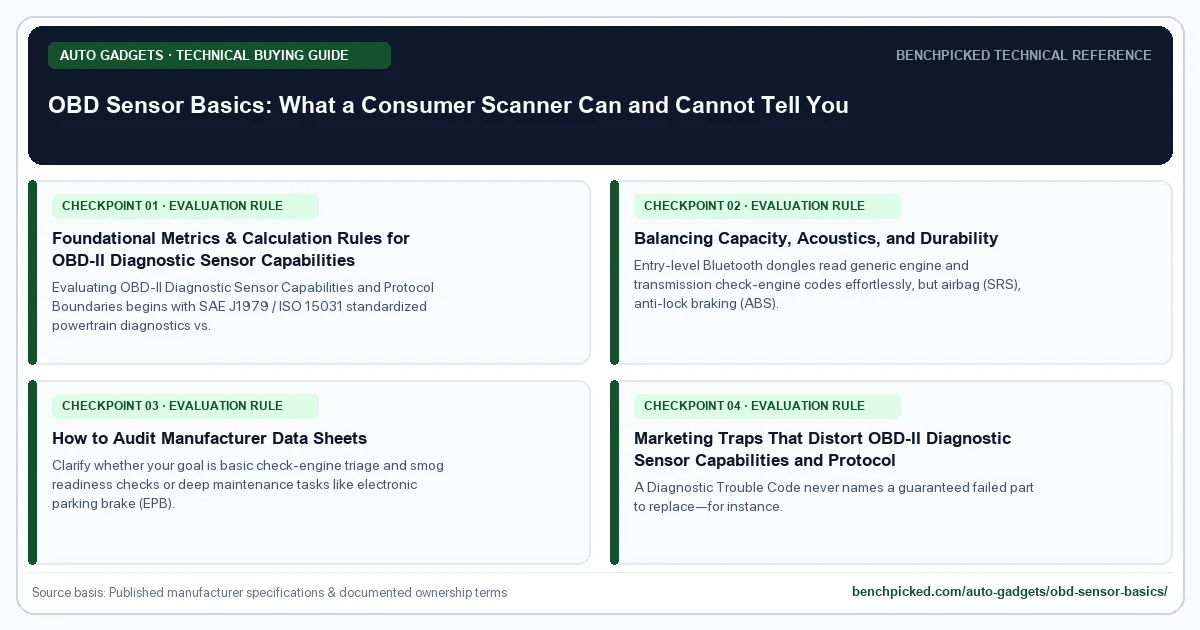
Foundational Metrics & Calculation Rules for OBD-II Diagnostic Sensor Capabilities and Protocol Boundaries
Evaluating OBD-II Diagnostic Sensor Capabilities and Protocol Boundaries begins with SAE J1979 / ISO 15031 standardized powertrain diagnostics vs OEM-specific CAN bus modules, where accurate comparisons depend on generic P0xxx Diagnostic Trouble Codes (DTCs), Mode 01 live PIDs, readiness monitors, and module-level coverage gaps. Every gasoline passenger vehicle sold in the US since 1996 (and diesel since 1997) exposes a 16-pin J1962 OBD-II port supporting five standard signaling protocols, standardized on CAN bus (ISO 15765-4) from model year 2008 onward. Standard Mode 01 through Mode 09 queries return emissions-related powertrain codes (P0xxx) and freeze-frame sensor snapshots across all brands.
Balancing Capacity, Acoustics, and Durability
Entry-level Bluetooth dongles read generic engine and transmission check-engine codes effortlessly, but airbag (SRS), anti-lock braking (ABS), tire pressure (TPMS), body control (BCM), and battery management (BMS) modules sit behind manufacturer-specific CAN identifiers. Reading or resetting those enhanced OEM modules requires licensed diagnostic databases and bi-directional control software that raise hardware or app costs.
How to Audit Manufacturer Data Sheets
Clarify whether your goal is basic check-engine triage and smog readiness checks or deep maintenance tasks like electronic parking brake (EPB) retraction, battery registration, and ABS bleeding. Verify that the adapter supports high-speed CAN and low-power sleep mode if you intend to leave it plugged into the OBD-II port overnight. Auditing how to audit manufacturer data sheets specifically for OBD Sensor Basics keeps your comparison grounded in verified obd sensor basics documentation rather than generic category assumptions.
Marketing Traps That Distort OBD-II Diagnostic Sensor Capabilities and Protocol Boundaries Comparisons
A Diagnostic Trouble Code never names a guaranteed failed part to replace—for instance, P0171 (System Too Lean Bank 1) indicates excess oxygen or insufficient fuel, which can stem from a cracked vacuum hose, dirty MAF sensor, or weak fuel pump rather than a bad O2 sensor. Never clear DTCs right before an emissions inspection; erasing codes resets all OBD readiness monitors to 'Incomplete,' causing an automatic smog check rejection until a full drive cycle completes.
Practical Checklist for Final Model Selection
A disciplined shortlist built around OBD-II Diagnostic Sensor Capabilities and Protocol Boundaries compares BlueDriver Bluetooth Pro OBD2 or OBDLink MX+, Viofo A119 Mini 2 or Garmin Dash Cam Mini 3, and Apple AirTag (4-Pack) or Samsung Galaxy SmartTag2 strictly on documented generic P0xxx Diagnostic Trouble Codes (DTCs), Mode 01 live PIDs, readiness monitors, and module-level coverage gaps. Whenever a seller omits key SAE J1979 / ISO 15031 standardized powertrain diagnostics vs OEM-specific CAN bus modules test conditions, treat that gap as a limiting factor and favor transparent manufacturers that publish complete engineering tables and spare-part pricing.
Full source-attributed specification record (0 fields)
Source notes
- SAE J1962 Diagnostic Connector Standard · Industry Standard · Checked Sep 19, 2026
- SAE J1979 Diagnostic Services Standard · Industry Standard · Checked Sep 19, 2026
- CSS Electronics OBD2 Introduction · Technical Reference · Checked Sep 19, 2026
Questions
Which specific numbers matter most when evaluating OBD-II Diagnostic Sensor Capabilities and Protocol Boundaries?
When auditing OBD-II Diagnostic Sensor Capabilities and Protocol Boundaries, prioritize generic P0xxx Diagnostic Trouble Codes (DTCs), Mode 01 live PIDs, readiness monitors, and module-level coverage gaps measured under standardized SAE J1979 / ISO 15031 standardized powertrain diagnostics vs OEM-specific CAN bus modules test conditions. Recording those exact baseline figures for OBD-II Diagnostic Sensor Capabilities and Protocol Boundaries lets you size hardware accurately without relying on peak promotional claims.
What design tradeoffs affect real-world OBD-II Diagnostic Sensor Capabilities and Protocol Boundaries performance?
Every product in SAE J1979 / ISO 15031 standardized powertrain diagnostics vs OEM-specific CAN bus modules balances generic P0xxx Diagnostic Trouble Codes (DTCs), Mode 01 live PIDs, readiness monitors, and module-level coverage gaps against physical size, acoustic output, and power or consumable draw. Pushing one variable higher in OBD-II Diagnostic Sensor Capabilities and Protocol Boundaries—such as compact housing or ultra-quiet sleep operation—inevitably requires a tradeoff in peak throughput or runtime.
How should I verify OBD-II Diagnostic Sensor Capabilities and Protocol Boundaries claims before ordering?
To verify OBD-II Diagnostic Sensor Capabilities and Protocol Boundaries before checkout, cross-check the manufacturer's engineering spec sheet for generic P0xxx Diagnostic Trouble Codes (DTCs), Mode 01 live PIDs, readiness monitors, and module-level coverage gaps and confirm replacement part or subscription pricing. If a listing omits verifiable SAE J1979 / ISO 15031 standardized powertrain diagnostics vs OEM-specific CAN bus modules disclosures for OBD-II Diagnostic Sensor Capabilities and Protocol Boundaries, treat that missing parameter as a hard operating limit.
Which models or benchmarks are best for comparing OBD-II Diagnostic Sensor Capabilities and Protocol Boundaries?
For a transparent OBD-II Diagnostic Sensor Capabilities and Protocol Boundaries comparison in SAE J1979 / ISO 15031 standardized powertrain diagnostics vs OEM-specific CAN bus modules, benchmark your shortlist against BlueDriver Bluetooth Pro OBD2 or OBDLink MX+, Viofo A119 Mini 2 or Garmin Dash Cam Mini 3, and Apple AirTag (4-Pack) or Samsung Galaxy SmartTag2. Compare each OBD-II Diagnostic Sensor Capabilities and Protocol Boundaries candidate across generic P0xxx Diagnostic Trouble Codes (DTCs), Mode 01 live PIDs, readiness monitors, and module-level coverage gaps, 3-year consumable or membership cost, and open-box return coverage before buying.
Before you buy
Recheck fit and current terms
Compare FIXD OBD2 Scanner Review: Free Fault Reader vs App Subscription with the criteria on this page, then confirm the current seller terms.
How BenchPicked separates published facts, analysis, and evidence limits