Air Quality research
HEPA filter grades
HEPA filter grades explained with source boundaries, specification context, and BenchPicked methodology notes.
Written by BenchPicked Editorial Team · Sources checked May 16, 2026
Executive Summary
Bottom line
HEPA Filter Grades and Particulate Media Standards defines DOE True HEPA (99.97% at 0.3 µm) and EN 1822 / ISO 29463 classifications by quantifying Most Penetrating Particle Size (MPPS around 0.3 microns) capture efficiency across H11, H12, True HEPA / H13, and H14 media. Use verified HEPA Filter Grades and Particulate Media Standards calculations, hardware tradeoff rules, and 3-year consumable math to compare models such as A higher-CADR purifier, A quieter compact purifier, and Source control or ventilation.
- Best Suited For
- people choosing a room air cleaner for a defined room and operating routine
- Core Buying Check
- use hepa filter grades to make a product decision without overreading promotional claims
- Key Evaluation Context
- matching cleaned-air delivery, noise, filter upkeep and room conditions
Decision matrix
Compare each documented specification against your room, routine, or operating requirements before checking live prices.
| Evaluation Factor | Documented Spec / Status | Buyer Takeaway |
|---|---|---|
| Primary engineering metric | Most Penetrating Particle Size (MPPS around 0.3 microns) capture efficiency across H11, H12, True HEPA / H13, and H14 media | Use Most Penetrating Particle Size (MPPS around 0.3 microns) capture efficiency across H11, H12, True HEPA / H13, and H14 media as your primary filter when sizing options in DOE True HEPA (99.97% at 0.3 µm) and EN 1822 / ISO 29463 classifications. |
| Sizing & calculation rule | True HEPA (equivalent to high-end H13 under EN 1822) captures at least 99. | Apply this formula to raw spec-sheet numbers rather than headline marketing banners. |
| 3-year ownership check | Hardware + consumables + power/subscriptions | Cross-check recurring filters, batteries, or membership fees across a higher-CADR purifier and competitors. |
Claim and evidence record
All 1 structured specification claims on this page are cross-referenced against the primary records listed below. Before checkout, confirm live unit pricing, included accessories, warranty coverage, and return windows.
When another option is the better fit
A higher-CADR purifier
Choose this when your room square footage demands A higher-CADR purifier's higher cubic-feet-per-minute airflow rather than HEPA filter grades's compact footprint.
A quieter compact purifier
Choose this when low-decibel bedside operation with A quieter compact purifier matters more to your bedroom setup than HEPA filter grades's maximum high-speed airflow.
Source control or ventilation
Choose this when addressing indoor pollutant sources or ventilation directly with Source control or ventilation is more effective than running HEPA filter grades continuously.
Product example
Apply these criteria to Levoit Core 300S: CADR, Room Fit, Noise, and Filter Costs
Use this approved product option as a concrete example while applying the criteria on this page. Confirm its published specifications and current seller terms before ordering.
Read the product researchCompare tested models: Coway Airmega AP-1512HHWinix 5510Air purifier noise levels
Research details
Foundational Metrics & Calculation Rules for HEPA Filter Grades and Particulate Media Standards
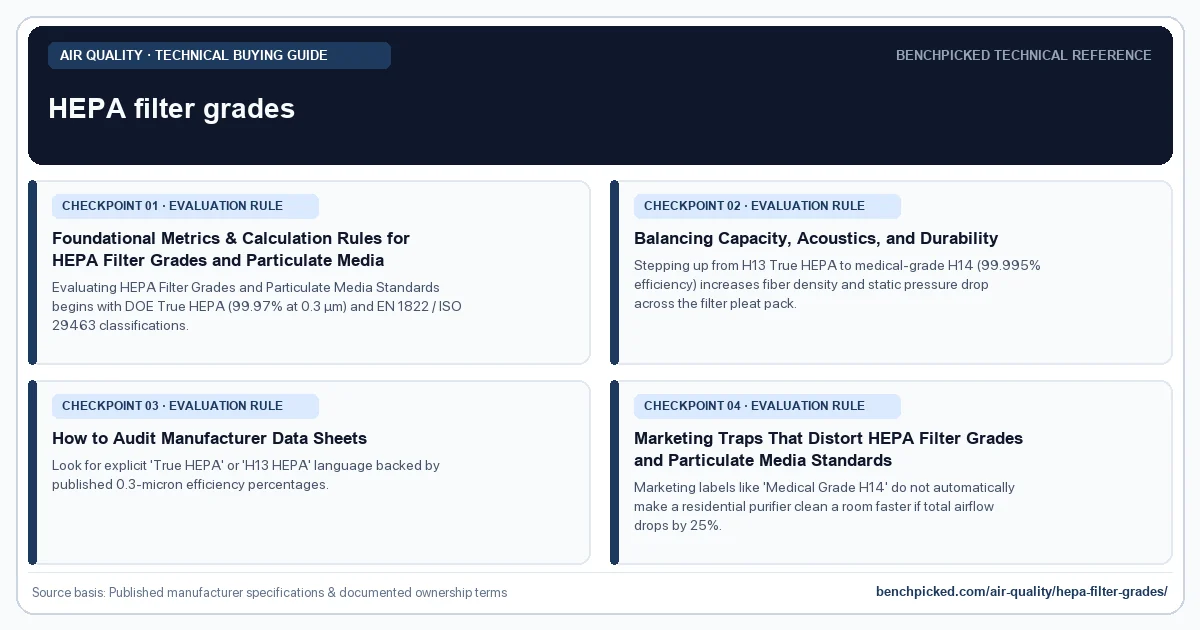
Evaluating HEPA Filter Grades and Particulate Media Standards begins with DOE True HEPA (99.97% at 0.3 µm) and EN 1822 / ISO 29463 classifications, where accurate comparisons depend on Most Penetrating Particle Size (MPPS around 0.3 microns) capture efficiency across H11, H12, True HEPA / H13, and H14 media. True HEPA (equivalent to high-end H13 under EN 1822) captures at least 99.97% of airborne particles measuring 0.3 microns in diameter. Both larger particles (pollen, mold spores above 2 microns) and smaller ultrafine particles (0.01–0.1 microns) are captured even more efficiently via impaction, interception, and Brownian diffusion.
Balancing Capacity, Acoustics, and Durability
Stepping up from H13 True HEPA to medical-grade H14 (99.995% efficiency) increases fiber density and static pressure drop across the filter pleat pack. Unless the purifier manufacturer pairs H14 media with a higher-torque brushless DC blower and deeper pleat geometry, an H14 swap often chokes total airflow (CFM) and reduces net room CADR compared with a balanced H13 cartridge.
How to Audit Manufacturer Data Sheets
Look for explicit 'True HEPA' or 'H13 HEPA' language backed by published 0.3-micron efficiency percentages, and avoid vague 'HEPA-type' or 'HEPA-style' phrasing that typically hides 85%–95% synthetic filters. Verify whether the unit relies on passive mechanical pleat density or an electrostatic ionizer assist to reach its headline efficiency rating. Always confirm that replacement filter cartridges include closed-cell foam gaskets so unfiltered room air cannot bypass the media frame.
Marketing Traps That Distort HEPA Filter Grades and Particulate Media Standards Comparisons
Marketing labels like 'Medical Grade H14' do not automatically make a residential purifier clean a room faster if total airflow drops by 25%. Furthermore, unsealed filter frames allow dirty intake air to bypass the pleated media entirely, rendering the filter grade meaningless unless the housing includes a continuous foam compression gasket. Auditing marketing traps that distort hepa filter grades and particulate media standards comparisons specifically for HEPA filter grades keeps your comparison grounded in verified hepa filter grades documentation rather than generic category assumptions.
Practical Checklist for Final Model Selection
A disciplined shortlist built around HEPA Filter Grades and Particulate Media Standards compares A higher-CADR purifier, A quieter compact purifier, and Source control or ventilation strictly on documented Most Penetrating Particle Size (MPPS around 0.3 microns) capture efficiency across H11, H12, True HEPA / H13, and H14 media. Whenever a seller omits key DOE True HEPA (99.97% at 0.3 µm) and EN 1822 / ISO 29463 classifications test conditions, treat that gap as a limiting factor and favor transparent manufacturers that publish complete engineering tables and spare-part pricing.
Full source-attributed specification record (0 fields)
Source notes
- EPA Guide To Air Cleaners In The Home · Government · Checked May 16, 2026
- AHAM Verifide Room Air Cleaner Directory · Industry Standard · Checked May 16, 2026
Questions
Which specific numbers matter most when evaluating HEPA Filter Grades and Particulate Media Standards?
When auditing HEPA Filter Grades and Particulate Media Standards, prioritize Most Penetrating Particle Size (MPPS around 0.3 microns) capture efficiency across H11, H12, True HEPA / H13, and H14 media measured under standardized DOE True HEPA (99.97% at 0.3 µm) and EN 1822 / ISO 29463 classifications test conditions. Recording those exact baseline figures for HEPA Filter Grades and Particulate Media Standards lets you size hardware accurately without relying on peak promotional claims.
What design tradeoffs affect real-world HEPA Filter Grades and Particulate Media Standards performance?
Every product in DOE True HEPA (99.97% at 0.3 µm) and EN 1822 / ISO 29463 classifications balances Most Penetrating Particle Size (MPPS around 0.3 microns) capture efficiency across H11, H12, True HEPA / H13, and H14 media against physical size, acoustic output, and power or consumable draw. Pushing one variable higher in HEPA Filter Grades and Particulate Media Standards—such as compact housing or ultra-quiet sleep operation—inevitably requires a tradeoff in peak throughput or runtime.
How should I verify HEPA Filter Grades and Particulate Media Standards claims before ordering?
To verify HEPA Filter Grades and Particulate Media Standards before checkout, cross-check the manufacturer's engineering spec sheet for Most Penetrating Particle Size (MPPS around 0.3 microns) capture efficiency across H11, H12, True HEPA / H13, and H14 media and confirm replacement part or subscription pricing. If a listing omits verifiable DOE True HEPA (99.97% at 0.3 µm) and EN 1822 / ISO 29463 classifications disclosures for HEPA Filter Grades and Particulate Media Standards, treat that missing parameter as a hard operating limit.
Which models or benchmarks are best for comparing HEPA Filter Grades and Particulate Media Standards?
For a transparent HEPA Filter Grades and Particulate Media Standards comparison in DOE True HEPA (99.97% at 0.3 µm) and EN 1822 / ISO 29463 classifications, benchmark your shortlist against A higher-CADR purifier, A quieter compact purifier, and Source control or ventilation. Compare each HEPA Filter Grades and Particulate Media Standards candidate across Most Penetrating Particle Size (MPPS around 0.3 microns) capture efficiency across H11, H12, True HEPA / H13, and H14 media, 3-year consumable or membership cost, and open-box return coverage before buying.
Before you buy
Recheck fit and current terms
Compare Levoit Core 300S: CADR, Room Fit, Noise, and Filter Costs with the criteria on this page, then confirm the current seller terms.
How BenchPicked separates published facts, analysis, and evidence limits